Event submissions
EventsThe 2nd International Electronic Conference on Medicinal Chemistry and Pharmaceutics
Published
This submission belongs to the session S5. Novel Methodologies and AI of the event The 2nd International Electronic Conference on Medicinal Chemistry and Pharmaceutics
Published date
29 Oct, 2026
Academic Editor
 Francisco Javier Otero Espinar
Contribution&Funding
Conceptualization,
[Shadma Wahab] ; [Suad Muawad]
Methodology,
[Shadma Wahab] ; [Roba Shaker Asiri]
Software,
[ Nada Al Dossari] ; [Suad Muawad] ; [Shadma Wahab]
Validation,
[Suad Muawad] ; [Wajd Fahad Alqahtani] ; [Shadma Wahab]
Formal analysis,
[ Nada Al Dossari] ; [Wajd Fahad Alqahtani] ; [Shadma Wahab]
Investigation,
[ Nada Al Dossari] ; [Wajd Fahad Alqahtani]
Resources,
[Shadma Wahab] ; [Wajd Fahad Alqahtani] ; [Roba Shaker Asiri]
Data curation,
[Roba Shaker Asiri] ; [Wajd Fahad Alqahtani] ; [Shadma Wahab]
Writing - original draft,
[Roba Shaker Asiri] ; [Suad Muawad] ; [ Nada Al Dossari]
Writing - review,
[editing] ; [Roba Shaker Asiri] ; [Suad Muawad] ; [ Nada Al Dossari]
Visualization,
[ Nada Al Dossari]
Supervision,
[Shadma Wahab]
Project administration,
[Shadma Wahab]
Funding acquisition,
[Shadma Wahab]
Funding: Deanship of Scientifice Research, King Khalid University
Citation
Shadma Wahab, Wajd Fahad Alqahtani, Roba Shaker Asiri, Suad Muawad, Nada Al Dossari, Drug repurposing of FDA-approved Bisantrene and Canagliflozin as potential CHK1 inhibitors: insights from molecular docking and molecular dynamics simulations, in Proceedings of The 2nd International Electronic Conference on Medicinal Chemistry and Pharmaceutics, 1 November–30 November 2026, MDPI: Basel, Switzerland
Share
Email
Facebook
Twitter
LinkedIn
Drug repurposing of FDA-approved Bisantrene and Canagliflozin as potential CHK1 inhibitors: insights from molecular docking and molecular dynamics simulations

Shadma Wahab 1
Wajd Fahad Alqahtani 1
Roba Shaker Asiri 1
Suad Muawad 1
Nada Al Dossari 1
1. Pharmacognosy, KING KHALID UNIVERSITY, Abha, 62521, Saudi Arabia
Abstract
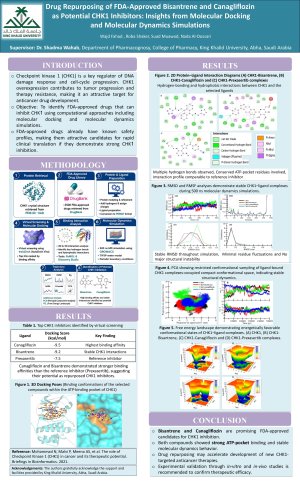
Checkpoint kinase 1 (CHK1) is an essential serine/threonine kinase involved in DNA damage response and cell cycle control. Dysregulated CHK1 activation has been found to be associated with tumor progression and resistance to various therapies in many cancer types and thus is an attractive target for development of anti-cancer drugs. In the present study, we use a structural-based virtual screening approach and screened 3500 FDA-approved drugs retrieved from Drug Bank. The molecular docking studies, which illustrated several potential candidates, showed that both Bisantrene and Canagliflozin achieved higher binding energies (-9.2 and -9.5 kcal/mol, respectively) than the reference inhibitor Prexasertib (-7.5 kcal/mol) according to docking with InstaDock. Interaction profiling showed that these ligands mainly occupied the ATP-binding site, interacting with the crucial catalytic residues (LEU15, GLY16, GLU17, GLY18, TYR20, GLU22, VAL23 and LYS38) through hydrogen bonds, pi-sigma interactions and hydrophobic contacts which implied stable and specific binding modes. Similarly, molecular dynamics simulations for 500 ns with GROMACS indicate studying docked complexes stability by reporting RMSD and overall compactness. PCA and FEL analyses further corroborated that both CHK1-Bisantrene and CHK1-Canagliflozin complexes had similar stability when compared to the CHK1-Prexasertib complex reference. Energy calculations and solvent exposure supported by these favorable binding and structural parameters. These results bring up Bisantrene and Canagliflozin as potential CHK1-binding candidates for repurposing in the form of anticancer drugs and recommended for further validation by in-vitro and in-vivo.
Keywords
Checkpoint kinase 1
Drug repurposing
Molecular docking
Molecular dynamics simulation
Cancer therapeutics.
Poster
Poster to present.pdf
“Development and Characterization of a High-Fat High-Sucrose Dietary Model of Obesity in Wistar Rats”
Development of a three-layered keratin-based nanofibrous scaffold as an in vitro model of the human nail barrier