Event submissions
EventsThe 2nd International Electronic Conference on Medicinal Chemistry and Pharmaceutics
Published
This submission belongs to the session S10. Biopharmaceutics, Disposition, Pharmacokinetics and Pharmacodynamics of the event The 2nd International Electronic Conference on Medicinal Chemistry and Pharmaceutics
Published date
29 Oct, 2026
Academic Editor
 Thierry Vandamme
Contribution&Funding
Funding: state assignment № 1022072600029-5-1.6.2;1.6.8
Citation
Mariya Pykhtina, Svetlana Miroshnichenko, Kirill Mosalev, Michael karpov, Maria Kotova, Anatoly Beklemishev, Chimeric form of GM-CSF in the treatment of burn wounds in rats, in Proceedings of The 2nd International Electronic Conference on Medicinal Chemistry and Pharmaceutics, 1 November–30 November 2026, MDPI: Basel, Switzerland
Share
Email
Facebook
Twitter
LinkedIn
Chimeric form of GM-CSF in the treatment of burn wounds in rats

Mariya Pykhtina 1
Svetlana Miroshnichenko 1
Kirill Mosalev 1
Michael karpov 2
Maria Kotova 1
Anatoly Beklemishev 3
1. Research Institute for Experimental and Clinical Medicine (NIIEKM), Federal Research Center of Fundamental and Translational Medicine, Novosibirsk, 630630, Russia
2. Department of Pathological Anatomy, Novosibirsk State Medical University of Minzdrav of Russia, Novosibirsk, 630630, Russia
3. Research Institute of Biochemistry , Federal Research Center of Fundamental and Translational Medicine, Novosibirsk, 630630, Russia
Abstract
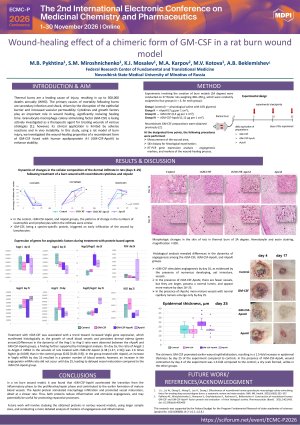
Thermal burns are a leading cause of injury, resulting in up to 300,000 deaths annually (WHO). The primary causes of mortality following burns are secondary infection and shock, driven by the disruption of the epithelial barrier and increased vascular permeability. Cytokines and growth factors play an important role in wound healing, significantly reducing healing time. Granulocyte-macrophage colony-stimulating factor (GM-CSF) is being actively investigated as a therapeutic agent for treating wounds of various etiologies; however, its clinical application is limited by adverse reactions and in vivo instability. In this study, using a rat model of burn injury, we investigated the wound-healing properties of a recombinant form of GM-CSF fused with human apolipoprotein A-I (GM-CSF-ApoAI) to enhance stability. The wound-healing efficacy of the chimeric protein was assessed by measuring changes in wound area, histological analysis, and the expression of genes encoding cytokines, angiogenesis markers, and markers of the wound-healing process. The treatment by chimeric GM-CSF accelerated the transition from the inflammatory phase toward the proliferative/repair phase, characterized by resolution of neutrophilic infiltration and increased macrophage and fibroblast presence. Furthermore, GM-CSF-ApoAI treatment increased Angpt1/Angpt2 mRNA ratio, consistent with histological data, which may indicate earlier formation of mature blood vessels. The chimeric GM-CSF promoted earlier wound epithelialization, resulting in a 1.5-fold increase in epidermal thickness by day 25 of the experiment compared to controls. The reduction of inflammation and normalization of blood supply to the wound bed under the influence of GM-CSF-ApoAI may facilitate the remodeling of scar tissue within a shorter timeframe.
Keywords
burn wound; wound healing; recombinant chimeric GM-CSF; inflammation; angiogenesis
Poster
M.B. Pykhtina, S.M. Miroshnichenko et al.pdf
Hydroxytyrosol‑Loaded Zein Nanoparticles: A Versatile Formulation for Pharmaceutical and Nutraceutical Applications
ABTS •+ Radical Quenching by Copper(II) Complexes of Salicylaldehyde Thiosemicarbazones
with Streptocide