Event submissions
EventsThe 2nd International Electronic Conference on Medicinal Chemistry and Pharmaceutics
Published
This submission belongs to the session S3. New Small Molecules as Drug Candidates of the event The 2nd International Electronic Conference on Medicinal Chemistry and Pharmaceutics
Published date
29 Oct, 2026
Academic Editor
 Mary J. Meegan
Contribution&Funding
Funding: This work was fulfilled with the financial support of the subprograms 010602 and 010701 of the institutional project.
Citation
Aliona Cotovaia, Ianina Graur, Victor Tsapkov, Olga Garbuz, Aurelian Gulea, ABTS •⁺ Radical Quenching by Copper(II) Complexes of Salicylaldehyde Thiosemicarbazones
with Streptocide, in Proceedings of The 2nd International Electronic Conference on Medicinal Chemistry and Pharmaceutics, 1 November–30 November 2026, MDPI: Basel, Switzerland
Share
Email
Facebook
Twitter
LinkedIn
ABTS •+ Radical Quenching by Copper(II) Complexes of Salicylaldehyde Thiosemicarbazones
with Streptocide

Aliona Cotovaia 1,2
Ianina Graur 2
Victor Tsapkov 2
Olga Garbuz 3
Aurelian Gulea 2
1. Department of Chemistry, Moldova State University, Chisinau, MD-2069, Moldova
2. Laboratory of Advanced Materials in Biopharmaceutics and Technics, Institute of Chemistry, Moldova State University, Moldova
3. Laboratory of Systematics and Molecular Phylogenetics, Institute of Zoology, Moldova State University, Moldova
Abstract
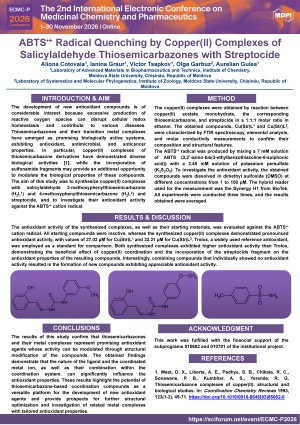
The development of new antioxidant compounds is of considerable interest because excessive production of reactive oxygen species can disrupt cellular redox homeostasis and contribute to various diseases. Thiosemicarbazones and their transition metal complexes have emerged as promising biologically active systems, exhibiting antioxidant, antimicrobial, and anticancer properties. In particular, copper(II) complexes of thiosemicarbazone derivatives have demonstrated diverse biological activities [1], while the incorporation of sulfonamide fragments may provide an additional opportunity to modulate the biological properties of these compounds.
The aim of this study was to synthesize copper(II) complexes with salicylaldehyde 3-methoxyphenylthiosemicarbazone (H2L1 ) and 4-methoxyphenylthiosemicarbazone (H2L2 ) and streptocide, and to investigate their antioxidant activity against the ABTS•+ cation radical. The copper(II) complexes were obtained by reaction between copper(II) acetate monohydrate, the corresponding thiosemicarbazone, and streptocide in a 1:1:1 molar ratio in ethanol. The obtained compounds, Cu(Str)L1 and Cu(Str)L2 , were characterized by FTIR spectroscopy, elemental analysis, and molar conductivity measurements to confirm their composition and structural features.
The antioxidant activity of the synthesized complexes, as well as their starting materials, was evaluated against the ABTS•+ cation radical. All starting compounds were inactive, whereas the synthesized copper(II) complexes demonstrated pronounced antioxidant activity, with values of 27.02 µM for Cu(Str)L1 and 22.21 µM for Cu(Str)L2. Trolox, a widely used reference antioxidant, was employed as a standard for comparison. Both synthesized complexes exhibited higher antioxidant activity than Trolox, demonstrating the beneficial effect of copper(II) coordination and the incorporation of the streptocide fragment on the antioxidant properties of the resulting compounds. This work was fulfilled with the financial support of the subprograms 010602 and 010701 of the institutional project.
[1] West, D. X., Liberta, A. E., Padhye, S. B., Chikate, R. C., Sonawane, P. B., Kumbhar, A. S., & Yerande, R. G. (1993). Thiosemicarbazone complexes of copper (II): structural and biological studies. Coordination Chemistry Reviews, 123(1-2), 49-71.
Keywords
thiosemicarbazone
copper(II) complex
antioxidant activity
Poster
Poster Cotovaia revised.pdf
Chimeric form of GM-CSF in the treatment of burn wounds in rats
From Sustainable Nanotechnology to Ovarian Cancer Theranostics: A Co-Creation Approach