Event submissions
EventsThe 2nd International Electronic Conference on Medicinal Chemistry and Pharmaceutics
Published
This submission belongs to the session S8. Nanomedicine and Nanotechnology of the event The 2nd International Electronic Conference on Medicinal Chemistry and Pharmaceutics
Published date
29 Oct, 2026
Academic Editor
 Thierry Vandamme
Contribution&Funding
Funding: Acknowledgements: This work was supported by the Portuguese Foundation for Science and Technology (FCT) in the framework of the Strategic Funding: UID/04650/2025 https://doi.org/10.54499/UID/04650/2025 (CF-UM-UP); UID/04378/2025 (DOI:10.54499/UID/04378/2025) and UID/PRR/04378/2025 (DOI:10.54499/UID/PRR/04378/2025) (UCIBIO) and LA/P/0140/2020 (DOI:10.54499/LA/P/0140/2020)(i4HB). Patrícia V. Teixeira acknowledges the financial support of the PhD research grant with reference 2025.01831.BDANA.
Citation
Patrícia V. Teixeira, Raquel Branquinho, Carla M. Lopes, Marlene Lúcio, From Sustainable Nanotechnology to Ovarian Cancer Theranostics: A Co-Creation Approach , in Proceedings of The 2nd International Electronic Conference on Medicinal Chemistry and Pharmaceutics, 1 November–30 November 2026, MDPI: Basel, Switzerland
Share
Email
Facebook
Twitter
LinkedIn
From Sustainable Nanotechnology to Ovarian Cancer Theranostics: A Co-Creation Approach

Patrícia V. Teixeira 1,2
Raquel Branquinho 2,3

Carla M. Lopes 4,5

Marlene Lúcio 1,2
1. Centre of Physics of the Universities of Minho and Porto (CF-UM-UP), School of Sciences, Gualtar Campus, University of Minho, Braga, 4710-057, Portugal
2. Armamar Scientific Capital Promotion Network (ARMA-Sci), Armamar Scientific Capital Promotion Network (ARMA-Sci), Armamar, 5110-128, Portugal
3. UCIBIO - Applied Molecular Biosciences Unit, Laboratory of Microbiology, Department of Biological Sciences, Faculty of Pharmacy, University of Porto, Rua Jorge de Viterbo Ferreira 228, Porto, 4050-313 , Portugal
4. RISE-Health, Faculty of Health Sciences, Fernando Pessoa University, Rua Carlos da Maia 296, Porto, 4200-150, Portugal
5. Associate Laboratory i4HB - Institute for Health and Bioeconomy, UCIBIO - Applied Molecular Biosciences Unit, MEDTECH, Laboratory of Pharmaceutical Technology, Department of Drug Sciences, Faculty of Pharmacy, University of Porto, Rua Jorge Viterbo Ferreira 228, Porto, 4050-313, Portugal
Abstract
Ovarian cancer remains among the deadliest gynecological diseases, highlighting the need
for innovative therapeutic strategies that combine enhanced treatment efficacy with
sustainable and socially inclusive approaches. This preliminary study investigated
doxorubicin association with graphene oxide quantum dots and its release under different
pH conditions.
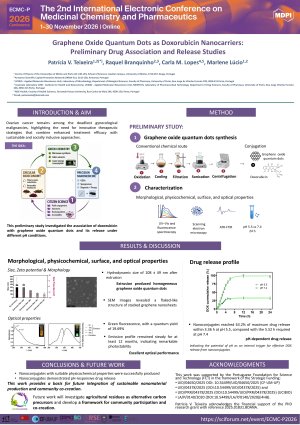
As a preliminary step, graphene oxide quantum dots were synthesized through a
conventional chemical route and evaluated as nanocarriers for the anticancer drug
doxorubicin. The nanoplatform was characterized by scanning electron microscopy,
dynamic light scattering, UV–Vis and fluorescence spectroscopy, and ATR-FTIR, providing
insights into its morphological, physicochemical, surface, and optical properties. The
resulting nanoconjugates exhibited a hydrodynamic size of 108 ± 49 nm and green
fluorescence, with a quantum yield of 19.69%. Drug release kinetics were evaluated by
dialysis at pH 5.5 and 7.4, at 37 ± 1 °C, over 24 h. The nanoconjugates reached 63.2% of the
maximum drug release after 3.36 h at pH 5.5, compared with 5.52 h at pH 7.4,
demonstrating pH-dependent drug release. These findings support the potential of the
nanoconjugates for tumor microenvironment-responsive drug delivery, while their intrinsic
fluorescence further supports their potential for bioimaging and theranostic applications.
Building on these preliminary findings, future work will investigate agricultural residues as
alternative carbon precursors and develop a framework for community participation and
co-creation.
Overall, this study supports the potential of these nanoconjugates as a pH-responsive
nanotheranostic platform combining drug delivery and intrinsic fluorescence for potential
cancer applications, while providing a basis for future integration of sustainable
nanomaterial production and community co-creation.
Keywords
Ovarian cancer
Nanotheranostics
pH-responsive drug delivery
Bioimaging
Sustainable nanotechnology
Co-creation
Poster
ECMC_ Patrícia Vilela _ Poster 2026.pdf
ABTS •+ Radical Quenching by Copper(II) Complexes of Salicylaldehyde Thiosemicarbazones
with Streptocide
Design and Characterization of Azithromycin-Loaded Pectin-Hyaluronic Acid Nano
Hydrogel for the Treatment of Skin Infections