Event submissions
EventsThe 2nd International Electronic Conference on Medicinal Chemistry and Pharmaceutics
Published
This submission belongs to the session S3. New Small Molecules as Drug Candidates of the event The 2nd International Electronic Conference on Medicinal Chemistry and Pharmaceutics
Published date
29 Oct, 2026
Academic Editor
 Alfredo Berzal-Herranz
Contribution&Funding
Conceptualization,
[Stoyanka Atanasova Nikolova] ; [Miglena Milusheva] ; [Darinka Slavcheva Dimitrova]
Methodology,
[Miglena Milusheva] ; [Kremena Saracheva] ; [Darinka Slavcheva Dimitrova] ; [Vera Nikolaeva Gledacheva] ; [Iliyana Dimitrova Stefanova]
Validation,
[Iliyana Dimitrova Stefanova] ; [Darinka Slavcheva Dimitrova] ; [Vera Nikolaeva Gledacheva]
Formal analysis,
[Kremena Saracheva] ; [Vera Nikolaeva Gledacheva] ; [Darinka Slavcheva Dimitrova] ; [Miglena Milusheva]
Investigation,
[Vera Nikolaeva Gledacheva] ; [Iliyana Dimitrova Stefanova] ; [Kremena Saracheva] ; [Darinka Slavcheva Dimitrova]
Data curation,
[Kremena Saracheva] ; [Darinka Slavcheva Dimitrova]
Writing - original draft,
[Kremena Saracheva] ; [Miglena Milusheva] ; [Darinka Slavcheva Dimitrova] ; [Iliyana Dimitrova Stefanova]
Writing - review,
[editing] ; [Stoyanka Atanasova Nikolova] ; [Darinka Slavcheva Dimitrova] ; [Vera Nikolaeva Gledacheva] ; [Miglena Milusheva]
Visualization,
[Vera Nikolaeva Gledacheva] ; [Miglena Milusheva] ; [Darinka Slavcheva Dimitrova] ; [Kremena Saracheva]
Supervision,
[Stoyanka Atanasova Nikolova]
Project administration,
[Darinka Slavcheva Dimitrova] ; [Stoyanka Atanasova Nikolova]
Funding: --
Citation
Miglena Milusheva, Darinka Slavcheva Dimitrova, Kremena Saracheva, Vera Nikolaeva Gledacheva, Iliyana Dimitrova Stefanova, Stoyanka Atanasova Nikolova, Comparative Assessment of Cognitive Effects of Anthranilamide Derivatives, in Proceedings of The 2nd International Electronic Conference on Medicinal Chemistry and Pharmaceutics, 1 November–30 November 2026, MDPI: Basel, Switzerland
Share
Email
Facebook
Twitter
LinkedIn
Comparative Assessment of Cognitive Effects of Anthranilamide Derivatives

Miglena Milusheva 1

Darinka Slavcheva Dimitrova 2
Kremena Saracheva 3

Vera Nikolaeva Gledacheva 4

Iliyana Dimitrova Stefanova 4

Stoyanka Atanasova Nikolova 5
1. Department of Bioorganic Chemistry, , Medical University of Plovdiv, Plovdiv, 4002 , Bulgaria
2. Department of Pharmacology and Clinical Pharmacology, Medical University of Plovdiv, Plovdiv, 4002 , Bulgaria
3. Department of Pharmacology and Drug Toxicology , Medical University of Plovdiv, Plovdiv, 4002 , Bulgaria
4. Department of Medical Physics and Biophysics, Medical University of Plovdiv, Plovdiv, 4002 , Bulgaria
5. Department of Organic Chemistry, University of Plovdiv, Plovdiv, 4000, Bulgaria
Abstract
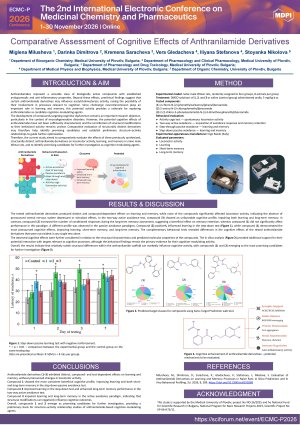
Anthranilamides have attracted increasing attention due to their antispasmodic and anti-inflammatory effects. Preclinical evidence suggests that these compounds may affect acetylcholinesterase activity, which could indirectly enhance cognitive performance. Therefore, the present study aimed to comparatively evaluate the effects of three previously synthesized anthranilamides, namely 2-chloro-N-(2-(phenethylcarbamoyl)phenyl)benzamide (1), 2-amino-N-(3-chlorophenethyl)benzamide (2), and 2-(2-chloro-2-phenylacetamido)-N-(3,4-dimethoxyphenethyl)benzamide (3), on cognitive functions in rats and to find them as potential active substances for neurodegenerative diseases treatment. In silico calculations, using SwissADME, Pro-Tox II, and PASS online, were performed. Two-way active avoidance test, activity cage test, and two passive avoidance tests – step-through and step-down test, were conducted. Overall, the obtained results imply that the anthranilamide scaffold has effects on cognitive processes, but these effects can be significantly altered by structural modifications. Our results demonstrate that anthranilamide derivatives do not produce a pronounced depressant or stimulant effect on the central nervous system. Two of the compounds, (1) and (2), showed cognitive-enhancing properties, with effects varying depending on the behavioral test applied, while compound (3)'s structural features might be less promising for this activity. These findings highlight the potential of specific anthranilamide derivatives as modulators of learning and memory processes. Therefore, the current results offer an initial SAR framework for more anthranilamide derivative improvement.
Keywords
cognitive functions
drug candidates
Alzheimer’s disease
anthranilamides
learning and memory tests
Poster
Poster ECMCP 1-30 Nov 2026.pdf
Design and Characterization of Azithromycin-Loaded Pectin-Hyaluronic Acid Nano
Hydrogel for the Treatment of Skin Infections