Event submissions
Published
 10.3390/chemproc2026022002 (registering DOI)
This submission belongs to the session Session 2. Chemistry of Bioorganics, Medicinal and Natural Products of the event The 30th International Electronic Conference on Synthetic Organic Chemistry
Published date
02 Nov, 2026
Academic Editor
 Julio A. Seijas
Citation
Oleksii Dykun, Viktor Anishchenko, Pavlo Kuzema, Andrii Redko, Volodymyr Rybachenko, Design, synthesis, identification, and spectroscopic study of the structure and tautomerism of gossypol imine derivatives, in Proceedings of The 30th International Electronic Conference on Synthetic Organic Chemistry, 5 November–19 November 2026, MDPI: Basel, Switzerland, doi: 10.3390/chemproc2026022002
Share
Email
Facebook
Twitter
LinkedIn
Design, synthesis, identification, and spectroscopic study of the structure and tautomerism of gossypol imine derivatives

Oleksii Dykun 1
Viktor Anishchenko 1
Pavlo Kuzema 2
Andrii Redko 1
Volodymyr Rybachenko 1
1. Spectrochemical research department, L.M. Litvynenko Institute of Physical-Organic Chemistry and Coal Chemistry of NAS of Ukraine, 50 Kharkivske Shose, Kyiv, 02155, Ukraine
2. Chuiko Institute of Surface Chemistry of NAS of Ukraine, 17, Oleh Mudrak str., Kyiv, 03164, Ukraine
Abstract
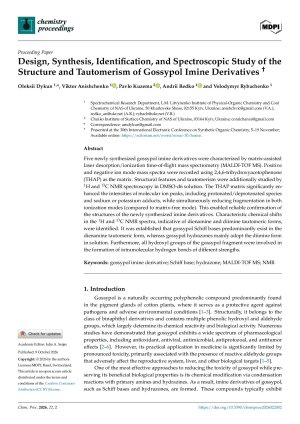
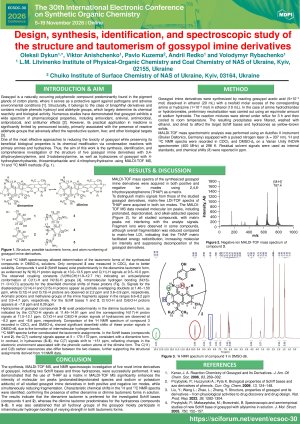
Gossypol, a natural polyphenolic compound, is considered a promising scaffold for the design of biologically active derivatives with pronounced antioxidant properties. In this study, newly synthesized gossypol imine derivatives were investigated in order to elucidate their structural features and tautomeric behavior.
Five newly synthesized gossypol imine derivatives were characterized by matrix-assisted laser desorption/ionization time-of-flight mass spectrometry (MALDI-TOF MS). Positive and negative ion mode mass spectra were recorded using 2,4,6-trihydroxyacetophenone (THAP) as the matrix. Structural features and tautomerism were additionally studied by 1H and 13C NMR spectroscopy in DMSO-d6 solution.
The THAP matrix significantly enhanced the intensities of molecular ion peaks, including protonated/deprotonated species and sodium or potassium adducts, while simultaneously reducing fragmentation in both ionization modes (compared to matrix-free mode). This enabled reliable confirmation of the structures of the newly synthesized imine derivatives. Characteristic chemical shifts in the 1H and 13C NMR spectra, indicative of dienamine and diimine tautomeric forms, were identified. It was established that gossypol Schiff bases predominantly exist in the dienamine tautomeric form, whereas gossypol hydrazones mainly adopt the diimine form in solution. Furthermore, all hydroxyl groups of the gossypol fragment were involved in the formation of intramolecular hydrogen bonds of different strength.
Design, synthesis, study of the structure and physicochemical properties of biologically active compounds on the basis of natural polyphenols from renewable raw materials is an economically sound basis and a necessary chemical step in the development of effective drugs.
Keywords
gossypol imine derivative; Schiff base
hydrazone
MALDI-TOF MS
NMR
Manuscript
Sciforum-186858 chemproc-22-00002.pdf
Poster
[Sciforum-186858] - [Poster] - [Submission accepted].pdf
Can Geranium Extracts Offer a Novel Therapeutic Approach for Obesity?
Access to bis-heterocyclic architectures via enol-Ugi reactions of privileged scaffolds