Event submissions
Published
 10.3390/chemproc2026022004 (registering DOI)
This submission belongs to the session Session 4. Physical Organic Chemistry of the event The 30th International Electronic Conference on Synthetic Organic Chemistry
Published date
02 Nov, 2026
Academic Editor
 Julio A. Seijas
Citation
Matías Capurso, Gabriel Radivoy, Fabiana Nador, Viviana Dorn, Santiago Stabile, Design of Thiohydroximate-Functionalised Catechol Ligands for Fe(III) Coordination Polymers, in Proceedings of The 30th International Electronic Conference on Synthetic Organic Chemistry, 5 November–19 November 2026, MDPI: Basel, Switzerland, doi: 10.3390/chemproc2026022004
Share
Email
Facebook
Twitter
LinkedIn
Design of Thiohydroximate-Functionalised Catechol Ligands for Fe(III) Coordination Polymers

Matías Capurso 1
Gabriel Radivoy 1
Fabiana Nador 1,2
Viviana Dorn 1
Santiago Stabile 1
1. Instituto de Química del Sur (INQUISUR-CONICET) - NANOSYN, Depto. de Química, Universidad Nacional del Sur, Bahía Blanca, 8000, Argentina
2. Helmholtz Institute of Pharmaceutical Research Saarland (HIPS) , Helmholtz Centre for Infection Research (HZI), Saarbrücken, 66123, Germany
Abstract
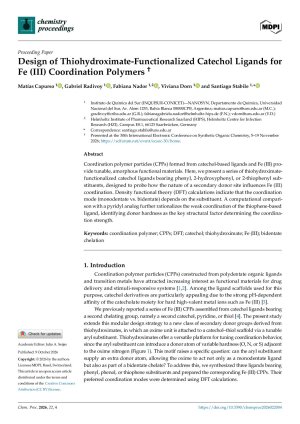
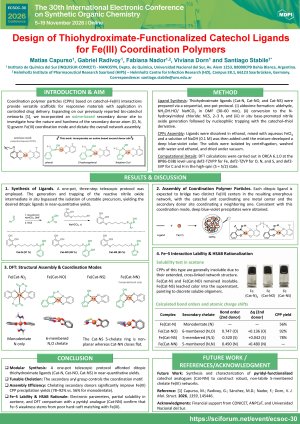
Coordination polymer particles (CPPs) based on catechol ligands and metal ions are versatile functional materials with potential applications in stimuli-responsive systems and drug delivery. Owing to their amorphous nature, their structures are often difficult to characterize experimentally, making computational approaches valuable for describing their coordination environments. Building on our previous work on Fe(III)-catechol CPPs, we report a new series of catechol-based ligands bearing a thiohydroximate moiety featuring phenyl, phenol, or thiophene substituents at the oxime carbon and connected to the catechol unit through a hexyl dithioether spacer. These ligands were designed to investigate how a tunable secondary chelation site influences polymer assembly.
The ligands were synthesized in two stages: first, catechol was oxidized and reacted with hexane-1,6-dithiol to afford a catechol-thiol precursor. Subsequently, thiohydroximate derivatives were prepared from the corresponding aldehydes through a one-pot, three-step telescopic synthesis involving: (i) aldoxime formation, (ii) conversion into the corresponding hydroximoyl chloride, and (iii) base-mediated generation of the corresponding nitrile oxide, which was trapped in situ by the catechol-thiol nucleophile to yield the target thiohydroximates. The CPPs were then assembled by reacting these ligands with ferric chloride in basic ethanol.
DFT calculations at the B3LYP-D3BJ/def2-TZVPP level showed that the phenyl derivative coordinates in a monodentate mode, whereas the phenol and thiophene derivatives form six- and five-membered bidentate chelates, respectively. Consistent with these predictions, the bidentate ligands afforded substantially higher CPP yields than the monodentate phenyl analogue, indicating that enhanced chelation promotes more efficient polymer assembly.
Keywords
coordination polymer; CPPs; DFT; catechol; thiohydroximate; Fe(III); bidentate chelation.
Manuscript
Sciforum-207707 chemproc-22-00004.pdf
Poster
[Sciforum-207707] - [Poster] - [Submission accepted].pdf
Access to bis-heterocyclic architectures via enol-Ugi reactions of privileged scaffolds
Direct meso-amidation of Biellamnn BODIPY