Event submissions
Published
 10.3390/chemproc2026022038 (registering DOI)
This submission belongs to the session Session 1. General Organic Synthesis of the event The 30th International Electronic Conference on Synthetic Organic Chemistry
Published date
02 Nov, 2026
Academic Editor
 Julio A. Seijas
Citation
Alexis S. Zamora-Vázquez, Eduardo Peña-Cabrera, Miguel A Vázquez, José L. Belmonte-Vázquez, Direct meso-amidation of Biellamnn BODIPY, in Proceedings of The 30th International Electronic Conference on Synthetic Organic Chemistry, 5 November–19 November 2026, MDPI: Basel, Switzerland, doi: 10.3390/chemproc2026022038
Share
Email
Facebook
Twitter
LinkedIn
Direct meso-amidation of Biellamnn BODIPY

Alexis S. Zamora-Vázquez 1
Eduardo Peña-Cabrera 1
Miguel A Vázquez 1
José L. Belmonte-Vázquez 2
1. Departamento de Quimica, Division de Ciencias Naturales y Exactas, Campus Guanajuato, Universidad de Guanajuato, Guanajuato, Mexico
2. Departamento de Química Orgánica, Facultad de Química (FQ), Universidad Nacional Autónoma de México (UNAM), Ciudad Universitaria, Ciudad de México 04510, México
Abstract
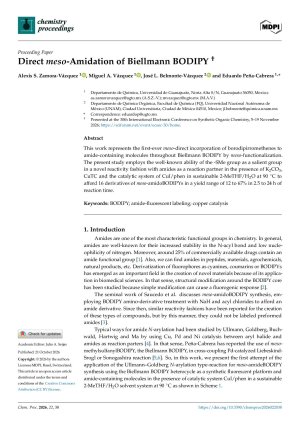
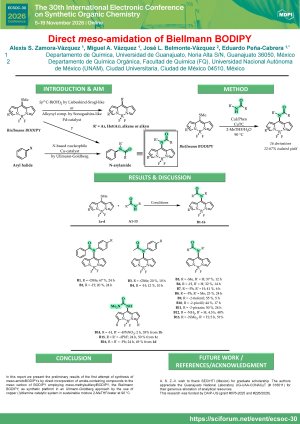
Meso-amidoBODIPYs represent a relatively new class of fluorescent materials typically synthesized from aminoBODIPY derivatives and acyl partners via traditional amide bond formation. Additionally, Biellmann BODIPYs have been widely studied as versatile building blocks for the meso-derivatization of the BODIPY core. This has been achieved by incorporating boronic acids and organostannanes through Liebeskind–Srogl palladium-catalyzed cross-coupling, or by introducing heteroatom-based nucleophiles (such as nitrogen, sulfur, or oxygen) via nucleophilic substitution reactions. While the introduction of amides to aryl halides has been extensively explored using the palladium-catalyzed Buchwald–Hartwig reaction and, more recently, the Ullmann copper/diamine approach due to copper's high abundance and cost-effectiveness, the direct introduction of amides at the BODIPY meso-position remains entirely unexplored.
Consequently, this work presents a novel derivatization strategy utilizing a synthetic method that couples Biellmann BODIPY with various amide-containing substrates via a modified Ullmann approach. This methodology employs copper(I) iodide as the catalyst and 1,10-phenanthroline as the ligand in a sustainable 2-methyltetrahydrofuran/water green solvent system. Through this efficient method, 16 distinct derivatives were successfully synthesized, with reaction times ranging from 2.5 to 24 hours and isolated yields between 12% and 67%. Notably, four of these sixteen obtained derivatives had been previously reported in the literature but required a more tedious two-step synthesis. Finally, the optical features of the new compounds aligned perfectly with the characteristic green-yellow emission region of the core BODIPY structure, which is consistent with the earliest literature reports.
Keywords
BODIPY
amide-fluorescent labeling
copper catalysis
Manuscript
Sciforum-202894.pdf
Poster
poster_202894_bodipyamidation.pdf
Design of Thiohydroximate-Functionalised Catechol Ligands for Fe(III) Coordination Polymers
Synthesis of Novel Mitochondria-Targeted Tranilast Derivatives with a Triphenylphosphonium Fragment in the Side Chain Exhibiting Enhanced In Vitro Antitumor Activity