Event submissions
Published
 10.3390/chemproc2026022039 (registering DOI)
This submission belongs to the session Session 2. Chemistry of Bioorganics, Medicinal and Natural Products of the event The 30th International Electronic Conference on Synthetic Organic Chemistry
Published date
02 Nov, 2026
Academic Editor
 Julio A. Seijas
Citation
Nora Khiar Fernández, Luis Alberto Prieto Ramírez, Victoria Esther Valdivia Giménez, Rafael León Martínez, Quentin Thiollier, Virginia Cutrano, Rocío Recio Jiménez, Inmaculada Fernández Fernández, Solution Stability and ADME-Guided Prioritisation of S-Glycosyl Nrf2-Modulating Isothiocyanates, in Proceedings of The 30th International Electronic Conference on Synthetic Organic Chemistry, 5 November–19 November 2026, MDPI: Basel, Switzerland, doi: 10.3390/chemproc2026022039
Share
Email
Facebook
Twitter
LinkedIn
Solution Stability and ADME-Guided Prioritisation of S-Glycosyl Nrf2-Modulating Isothiocyanates

Nora Khiar Fernández 1
Luis Alberto Prieto Ramírez 2
Victoria Esther Valdivia Giménez 2

Rafael León Martínez 3
Quentin Thiollier 2
Virginia Cutrano 2
Rocío Recio Jiménez 2
Inmaculada Fernández Fernández 2
1. Departamento de Química Orgánica, Facultad de Ciencias Químicas. Universidad Complutense de Madrid, 28040 Madrid, Spain.
2. Departamento de Química Orgánica y Farmacéutica. Facultad de Farmacia. Universidad de Sevilla, 41012 Sevilla, Spain.
3. Instituto de Química Médica, Consejo Superior de Investigaciones Científicas (IQM-CSIC), 28006 Madrid, Spain.
Abstract
Introduction
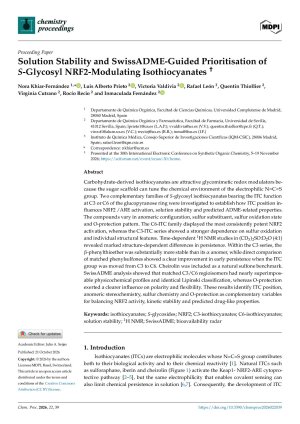
Carbohydrate-derived isothiocyanates are valuable glycomimetic analogues of natural electrophilic redox modulators such as sulforaphane and iberin. Among them, C6-isothiocyanate S-glycosides offer a particularly attractive scaffold, combining the electrophilic N=C=S pharmacophore with a sugar framework able to modulate polarity, aqueous behavior and molecular recognition. Beyond Nrf2 potency, the selection of promising redox modulators requires consideration of chemical stability and predicted drug-like properties.
Methods
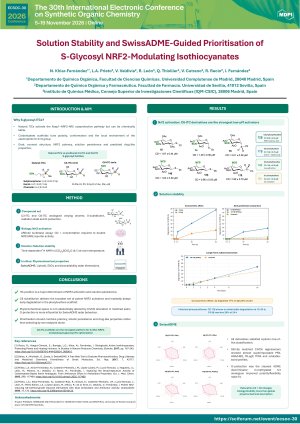
A focused set of C6-isothiocyanate S-glycosyl derivatives was evaluated by integrating Nrf2 activation, stability in aqueous DMSO and in silico pharmacokinetic descriptors. Stability was assessed by time-dependent 1H NMR experiments in a (CD₃)₂SO:D₂O mixture, following diagnostic resonances over time. ADME descriptors and bioavailability radar plots were calculated using SwissADME to compare solubility, lipophilicity, size, polarity, saturation, flexibility and overall drug-likeness across representative derivatives.
Results
The combined analysis identified selected C6-isothiocyanate S-glycosides with a favorable balance between Nrf2-modulating activity, chemical robustness in aqueous DMSO and predicted ADME profile. The phenylsulfone β-S-glycosyl C6-isothiocyanate derivative showed no appreciable degradation after 24 h under the tested conditions, with only slow spectral evolution at longer incubation times. Bioavailability radar plots revealed how the nature of the anomeric sulfur substituent and its oxidation state influence the global developability profile.
Conclusions
C6-isothiocyanate S-glycosides constitute chemically robust carbohydrate-based Nrf2 modulators. Integrating biological activity, 1H NMR-monitored stability in aqueous DMSO and predicted ADME descriptors provides a rational framework for prioritizing electrophilic glycomimetics beyond potency alone.
Acknowledgments: Project PID2022-138863OB-I00 funded by MICIU/AEI/10.13039/501100011033 and by ERDF/EU.
Keywords
Glycomimetics
Chemical stability
ADME prediction
Drug-likeness
Nrf2 activators.
Manuscript
Sciforum-202724.pdf
Poster
[Sciforum-202724] - [Poster] - [Submission accepted].pdf
Green Synthesis, Physicochemical Characterization, Antioxidant and Antibacterial Activities of Cissampelos pareira-Mediated Silver Nanoparticles
Towards Safer and More Sustainable PVDF-Based Ionogels for Electrochemical Energy Storage