Event submissions
Published
 10.3390/chemproc2026022041 (registering DOI)
This submission belongs to the session Session 2. Chemistry of Bioorganics, Medicinal and Natural Products of the event The 30th International Electronic Conference on Synthetic Organic Chemistry
Published date
02 Nov, 2026
Academic Editor
 Julio A. Seijas
Citation
Charles O. Nnadi, Paul C. Onwuasoanya, Chizelum C. Mgbe, Sandra I. Abana, James E. Sunday, Blessing E. Ugwuodo, Lilian I. Nweke, Emmanuel C. Okoro, Amara A. Nwose, Chikaodili S. Ugwuanyi , Wilfred O. Obonga, Network Pharmacology Analysis of Piper guineense-Derived Phytochemical Compounds for Wound Healing Activity, in Proceedings of The 30th International Electronic Conference on Synthetic Organic Chemistry, 5 November–19 November 2026, MDPI: Basel, Switzerland, doi: 10.3390/chemproc2026022041
Share
Email
Facebook
Twitter
LinkedIn
Network Pharmacology Analysis of Piper guineense-Derived Phytochemical Compounds for Wound Healing Activity

Charles O. Nnadi 1,2,3

Paul C. Onwuasoanya 1
Chizelum C. Mgbe 1
Sandra I. Abana 1
James E. Sunday 1
Blessing E. Ugwuodo 1
Lilian I. Nweke 1,2
Emmanuel C. Okoro 1
Amara A. Nwose 1
Chikaodili S. Ugwuanyi 1
Wilfred O. Obonga 1
1. Department of Pharmaceutical and Medicinal Chemistry, Faculty of Pharmaceutical Sciences, University of Nigeria Nsukka, Nsukka, 410001, Nigeria
2. Department of Pharmaceutical and Medicinal Chemistry, Faculty of Pharmacy, State University of Medical and Applied Sciences, Igbo-Eno, 410001 Enugu State, Nigeria
3. Department of Pharmaceutical and Medicinal Chemistry, Faculty of Pharmacy, Maduka University, Ekwegbe-Nsukka, 420001, Enugu State, Nigeria
Abstract
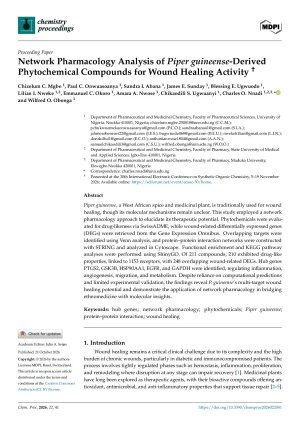
Piper guineense, a West African spice and medicinal plant, is traditionally employed for wound healing, yet the molecular mechanisms underlying its therapeutic activity remain poorly defined. This study aimed to elucidate the wound‑healing potential of P. guineense phytochemicals using a network pharmacology approach. The drug-likeness properties and predicted targets of reported phytochemicals were assessed via SwissADME. Differentially expressed genes (DEGs) associated with wound pathogenesis were retrieved from the Gene Expression Omnibus, and overlapping genes were identified using the Bioinformatic and Evolutionary Genomics Venn diagram. Protein–protein interaction (PPI) networks were constructed with STRING and analyzed in Cytoscape. Functional enrichment and KEGG pathway analyses were performed using ShinyGO. Of 211 identified compounds including fatty acid esters, terpenoids, phenolics, benzodioxoles, lactones, and alkaloid‑like molecules, 210 exhibited drug‑like properties. These were linked to 1153 genes, of which 248 overlapped with 10,300 wound‑related DEGs. The PPI network revealed dense interconnections (248 nodes, 1618 edges, average node degree 13, clustering coefficient 0.479, enrichment p < 1.0e⁻¹⁶). Gene enrichment highlighted five hub genes: PTGS2, GSK3B, HSP90AA1, EGFR, and GAPDH. These targets regulate inflammation, proliferation, migration, protein folding, stress response, and energy metabolism. Several compounds were predicted to interact with PTGS2, GSK3B, HSP90AA1, and EGFR, supporting coordinated multi‑target actions. In conclusion, P. guineense demonstrates wound‑healing potential through synergistic regulation of inflammation, angiogenesis, re‑epithelialization, and tissue remodeling. This study underscores the utility of network pharmacology in bridging traditional medicine with modern molecular insights.
Keywords
Hub genes; Network pharmacology; Phytochemicals; Piper guineense; Protein–protein interaction; Wound healing
Manuscript
Sciforum-207683.pdf
Poster
[Sciforum-207683] - [Poster] - [Submission accepted].pdf
Towards Safer and More Sustainable PVDF-Based Ionogels for Electrochemical Energy Storage
AI-Guided Optimization and Structure-Based Virtual Screening Identify Novel Dual-State KRAS G12D Inhibitor Candidates