Event submissions
Published
 10.3390/chemproc2026022007 (registering DOI)
This submission belongs to the session Session 2. Chemistry of Bioorganics, Medicinal and Natural Products of the event The 30th International Electronic Conference on Synthetic Organic Chemistry
Published date
02 Nov, 2026
Academic Editor
 Julio A. Seijas
Citation
Mohamed Khattab, Muhammad Mehtab, Rakin Khan, AI-Guided Optimization and Structure-Based Virtual Screening Identify Novel Dual-State KRAS G12D Inhibitor Candidates, in Proceedings of The 30th International Electronic Conference on Synthetic Organic Chemistry, 5 November–19 November 2026, MDPI: Basel, Switzerland, doi: 10.3390/chemproc2026022007
Share
Email
Facebook
Twitter
LinkedIn
AI-Guided Optimization and Structure-Based Virtual Screening Identify Novel Dual-State KRAS G12D Inhibitor Candidates

Mohamed Khattab 1
Muhammad Mehtab 2
Rakin Khan 3
1. Department of Medicinal Chemistry, Faculty of Clinical Pharmacy, Suez Canal University, Ismailia 41522, Egypt
2. Fazaia Medical College, Air University, Islamabad, Pakistan
3. Biology, King George V School, Hong Kong, China
Abstract
KRAS G12D is one of the most prevalent oncogenic drivers in pancreatic and colorectal cancers and remains a challenging therapeutic target because of its high affinity for GTP and the absence of a reactive residue for covalent inhibition. Identifying non-covalent inhibitors capable of targeting multiple conformational states may provide an effective strategy to overcome these limitations. An open-source computational workflow integrating HTV-screening, molecular docking, AI-guided ligand optimization using DeepFrag, and ADMET prediction was employed to identify and optimize potential dual-state KRAS G12D inhibitors. FDA- and internationally approved compounds from the ZINC World-approved library were screened against the inactive (7RPZ) and active (7T47) KRAS G12D crystal structures. Promising candidates were structurally optimized and subsequently evaluated for binding affinity, binding interactions, and predicted pharmacokinetic properties. Virtual screening identified split1062 as a promising dual-state scaffold suitable for AI-guided optimization. Three derivatives were generated, among opt3 retained favorable predicted docking scores against both conformational states while improving its predicted drug-like properties. Interaction analysis revealed conserved hydrogen bonding with the mutant Asp12 residue in both conformational states. ADMET profiling indicated that opt3 satisfied Lipinski's Rule of Five, exhibited high predicted gastrointestinal absorption, lacked PAINS and Brenk alerts, and eliminated the predicted blood-brain barrier permeability observed for the parent compound while maintaining favorable drug-like properties. This study suggest that integrating AI-guided ligand optimization with virtual screening can improve the predicted binding and pharmacokinetic properties of repurposed KRAS G12D inhibitors.
Keywords
KRAS G12D
molecular docking
drug repurposing
DeepFrag
artificial intelligence
virtual screening
ADMET
dual-state inhibition.
Manuscript
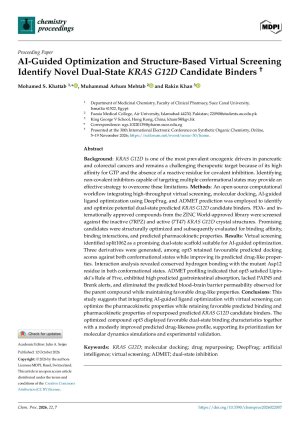
Sciforum-207031 chemproc-22-00007.pdf
Poster
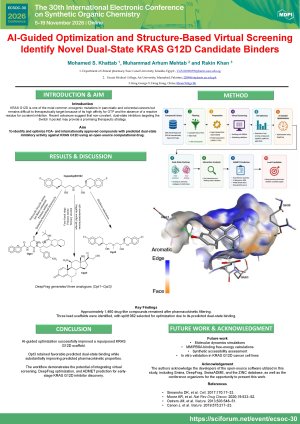
[Sciforum-207031] - [Poster] - [Submission accepted].pdf
Network Pharmacology Analysis of Piper guineense-Derived Phytochemical Compounds for Wound Healing Activity
In Silico Exploration of Natural Polyphenols Targeting Angiogenesis Pathways for Wound Healing: Molecular Docking Analysis Against VEGFR-2