Event submissions
Published
 10.3390/chemproc2026022008 (registering DOI)
This submission belongs to the session Session 2. Chemistry of Bioorganics, Medicinal and Natural Products of the event The 30th International Electronic Conference on Synthetic Organic Chemistry
Published date
02 Nov, 2026
Academic Editor
 Julio A. Seijas
Citation
Sumana Das, Anima Pandey, In Silico Exploration of Natural Polyphenols Targeting Angiogenesis Pathways for Wound Healing: Molecular Docking Analysis Against VEGFR-2, in Proceedings of The 30th International Electronic Conference on Synthetic Organic Chemistry, 5 November–19 November 2026, MDPI: Basel, Switzerland, doi: 10.3390/chemproc2026022008
Share
Email
Facebook
Twitter
LinkedIn
In Silico Exploration of Natural Polyphenols Targeting Angiogenesis Pathways for Wound Healing: Molecular Docking Analysis Against VEGFR-2

Sumana Das 1
Anima Pandey 1
1. Department of Pharmaceutical Sciences and Technology, Birla Institute of Technology, Mesra, Ranchi, Jharkhand 835215, India
Abstract
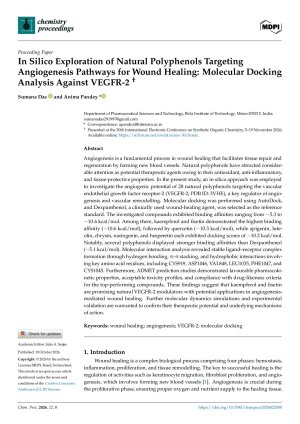
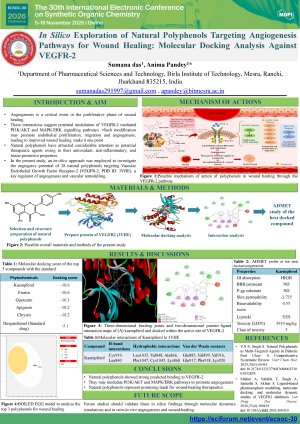
Angiogenesis is a fundamental process in wound healing that facilitates tissue repair and regeneration through the formation of new blood vessels. Natural polyphenols have attracted considerable attention as potential therapeutic agents owing to their antioxidant, anti-inflammatory, and tissue-protective properties. In the present study, an in silico approach was employed to investigate the angiogenic potential of 30 natural polyphenols targeting Vascular Endothelial Growth Factor Receptor-2 (VEGFR-2; PDB ID: 3VHE), a key regulator of angiogenesis and vascular remodeling. Molecular docking was performed using AutoDock, and Dexpanthenol, a clinically used wound-healing agent, was selected as the reference standard. The investigated compounds exhibited binding affinities ranging from −5.3 to −10.6 kcal/mol. Among them, kaempferol and fisetin demonstrated the highest binding affinity (−10.6 kcal/mol), followed by quercetin (−10.3 kcal/mol), while apigenin, luteolin, chrysin, naringenin, and hesperetin each exhibited docking scores of −10.2 kcal/mol. Notably, several polyphenols displayed stronger binding affinities than Dexpanthenol (−9.0 kcal/mol). Molecular interaction analysis revealed stable ligand–receptor complex formation through hydrogen bonding, π–π stacking, and hydrophobic interactions involving key amino acid residues, including CYS919, ASP1046, VAL848, LEU1035, PHE1047, and CYS1045. Furthermore, ADMET prediction studies demonstrated favorable pharmacokinetic properties, acceptable toxicity profiles, and compliance with drug-likeness criteria for the top-performing compounds. These findings suggest that kaempferol and fisetin are promising natural VEGFR-2 modulators with potential applications in angiogenesis-mediated wound healing. Further molecular dynamics simulations and experimental validation are warranted to confirm their therapeutic potential and underlying mechanisms of action.
Keywords
Wound healing
Angiogenesis
VEGFR-2
Molecular docking
Manuscript
Sciforum-200740 chemproc-22-00008.pdf
Poster
[Sciforum-200740] - [Poster] - [Submission accepted].pdf
AI-Guided Optimization and Structure-Based Virtual Screening Identify Novel Dual-State KRAS G12D Inhibitor Candidates
Eco-Friendly Microwave-Assisted Synthesis and Complete 2D NMR Analysis of Tryptanthrin