Event submissions
Published
 10.3390/chemproc2026022042 (registering DOI)
This submission belongs to the session Session 1. General Organic Synthesis of the event The 30th International Electronic Conference on Synthetic Organic Chemistry
Published date
02 Nov, 2026
Academic Editor
 Julio A. Seijas
Citation
Gisela Celeste Muscia, Daniela Mansilla, Silvia Asís, Eco-Friendly Microwave-Assisted Synthesis and Complete 2D NMR Analysis of Tryptanthrin, in Proceedings of The 30th International Electronic Conference on Synthetic Organic Chemistry, 5 November–19 November 2026, MDPI: Basel, Switzerland, doi: 10.3390/chemproc2026022042
Share
Email
Facebook
Twitter
LinkedIn
Eco-Friendly Microwave-Assisted Synthesis and Complete 2D NMR Analysis of Tryptanthrin

Gisela Celeste Muscia 1
Daniela Mansilla 1
Silvia Asís 1
1. Facultad de Farmacia y Bioquímica, Universidad de Buenos Aires, Junín 956. Ciudad Autónoma de Buenos Aires C1113AAB, Argentina
Abstract
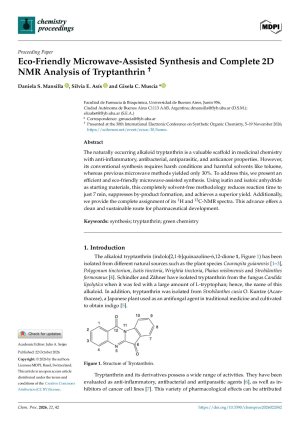
The naturally occurring alkaloid tryptanthrin (indolo[2,1-b]quinazoline-6,12-dione) is a highly valuable scaffold in medicinal chemistry. Featuring a unique combination of a quinazolinone nucleus and a condensed indole ring, it exhibits a broad spectrum of pharmacological activities, including potent anti-inflammatory, antibacterial, antiparasitic, and anticancer properties.
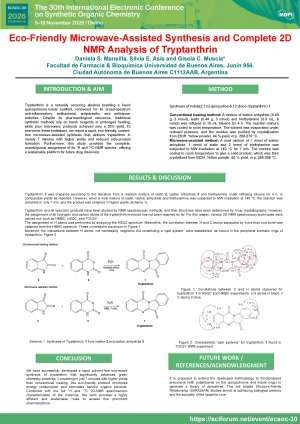
Despite its biological relevance, traditional synthetic routes toward tryptanthrin often suffer from significant drawbacks. Conventional methods typically require drastic reaction conditions, harsh reagents, or prolonged heating times using environmentally harmful solvents such as toluene. While a recent attempt utilizing microwave-assisted reduction has been reported, it achieved only a 30% yield, leaving the efficient and high-yielding microwave synthesis of this molecule an unresolved challenge.
To overcome these limitations, we report a novel, eco-friendly, and highly efficient microwave-assisted synthesis of tryptanthrin. Mainly, this methodology is entirely solvent-free, eliminating the need for toxic organic media and adhering strictly to the principles of green chemistry. By applying microwave irradiation, the reaction time was drastically reduced to merely 7 minutes. Compared to conventional heating methods, our approach not only significantly accelerates the process but also suppresses the formation of unwanted by-products, ultimately affording the target alkaloid in a substantially higher yield. Furthermore, this study presents the complete and unambiguous assignment of all signals in the 1H and 13C NMR spectra of the synthesized molecule.
In conclusion, this unprecedented solvent-free microwave synthesis provides a rapid, clean, and superior route to obtain tryptanthrin, facilitating sustainable access to this prominent pharmacophore for future drug discovery and biological screening.
Keywords
Synthesis
Tryptanthrin
green chemistry
microwave
Manuscript
Sciforum-202034.pdf
Poster
[Sciforum-202034] - [Poster] - [Submission accepted].pdf
In Silico Exploration of Natural Polyphenols Targeting Angiogenesis Pathways for Wound Healing: Molecular Docking Analysis Against VEGFR-2
Mechanistic study of the intramolecular hemiacetalization of warfarin: transition states and reaction pathways from DFT calculations.