Event submissions
Published
 10.3390/chemproc2026022044 (registering DOI)
This submission belongs to the session Session 3. Design and Application of Organic/Supramolecular Assemblies of the event The 30th International Electronic Conference on Synthetic Organic Chemistry
Published date
02 Nov, 2026
Academic Editor
 Julio A. Seijas
Citation
Kseniia Nikolaevna Grafskaia, Vera Alexandrovna Solovyeva, Pranay Asthana, A Self-Healing Elastomer Synthesis for Flexible Wet Electrical Connectors Based on Reversible Supramolecular Interactions, in Proceedings of The 30th International Electronic Conference on Synthetic Organic Chemistry, 5 November–19 November 2026, MDPI: Basel, Switzerland, doi: 10.3390/chemproc2026022044
Share
Email
Facebook
Twitter
LinkedIn
A Self-Healing Elastomer Synthesis for Flexible Wet Electrical Connectors Based on Reversible Supramolecular Interactions

Kseniia Nikolaevna Grafskaia 1
Vera Alexandrovna Solovyeva 1
Pranay Asthana 2
1. Aramco Innovations, Moscow, Russia
2. Saudi Aramco, Dhahran, Saudi Arabia
Abstract
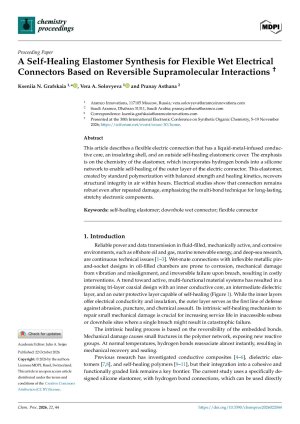
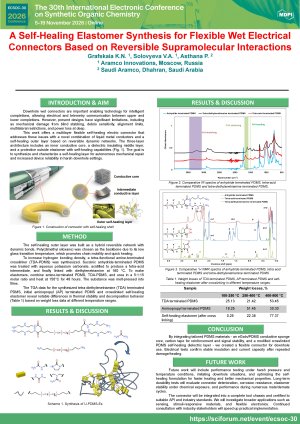
A multilayer flexible electrical connector consisting of a conductive core, an insulating shell, and an outer self-healing shell was developed. This paper presents the synthesis and testing of the organic polymer materials constituting each layer, with a particular emphasis on the chemical design and dynamic molecular interactions governing autonomous self-repair.
The conductive core was prepared by incorporating liquid metal fillers into a polymer to achieve efficient current transfer. The outer healing layer was synthesized from a polysiloxane-based elastomer capable of reversible supramolecular interactions, including hydrogen-bonding motifs. The synergistic contribution of these dynamic interactions enabled autonomous recovery from puncture-induced damage. The elastomer was obtained using conventional silicone polymerization and subsequently modified with polar polyamine terminal groups, with the ratio optimized to achieve a balance between mechanical robustness and self-healing kinetics.
Experimental characterization demonstrated that the conductive core satisfied targeted current-transfer requirements. The self-healing polysiloxane coating exhibited substantial structural recovery within several hours after puncture-induced damage under both ambient and aqueous conditions. The pre-designed combination of hydrophobic polysiloxane backbones and polyamine functionalities capable of hydrogen bonding effectively insulated internal conductive core from ingress while promoting self-healing due to reversible supramolecular interactions.
These results demonstrate a molecular design strategy for multifunctional self-healing conductive polymeric systems, providing a promising synthetic approach toward durable, stretchable, and environmentally resilient materials for next-generation flexible electronic applications.
Keywords
Self-healing elastomers
conductive polymer composites
flexible electronic connectors
stretchable electronics
Manuscript
Sciforum-201816.pdf
Poster
[Sciforum-201816] - [Poster] - [Submission accepted].pdf
Identification of Quinazoline-Based EGFR Inhibitors Against Triple-Negative Breast Cancer Using an Integrated In Silico Approach
Phytomediated Synthesis of Copper Nanoparticles Using Jatropha curcas Latex and Their Synergistic Antimicrobial Activity against Pathogenic Microorganisms