Event submissions
Published
 10.3390/chemproc2026022014 (registering DOI)
This submission belongs to the session Session 1. General Organic Synthesis of the event The 30th International Electronic Conference on Synthetic Organic Chemistry
Published date
02 Nov, 2026
Academic Editor
 Julio A. Seijas
Citation
Emmanuel Martínez Rodríguez, Sergio E. Solorio Hernández, Miguel A. Vázquez, José G. Becerra González, Eduardo Peña Cabrera, The Steglich coupling reaction as a strategy for fluorescent labeling of drugs through BODIPY incorporation, in Proceedings of The 30th International Electronic Conference on Synthetic Organic Chemistry, 5 November–19 November 2026, MDPI: Basel, Switzerland, doi: 10.3390/chemproc2026022014
Share
Email
Facebook
Twitter
LinkedIn
The Steglich coupling reaction as a strategy for fluorescent labeling of drugs through BODIPY incorporation

Emmanuel Martínez Rodríguez 1
Sergio E. Solorio Hernández 1
Miguel A. Vázquez 1
José G. Becerra González 1
Eduardo Peña Cabrera 1
1. Department of Chemistry, Division of Natural and Exact Sciences, University of Guanajuato, Guanajuato, 36050
Abstract
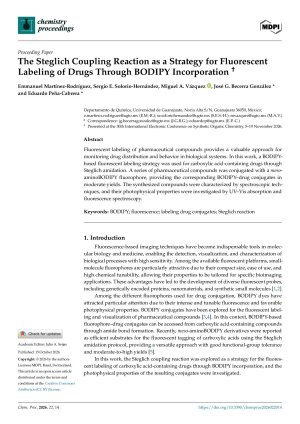
Fluorescent labeling of drugs constitutes a valuable strategy for investigating the behavior of biologically active molecules within living systems. The incorporation of a fluorophore into a drug structure enables the monitoring of its distribution, absorption, and interactions with biological targets through spectroscopic techniques.
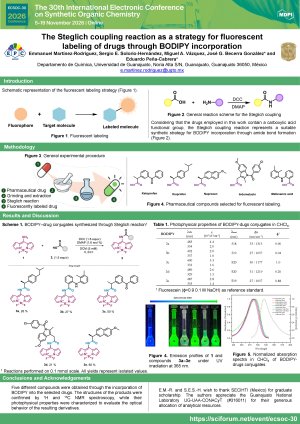
The Steglich coupling reaction constitutes an efficient and versatile synthetic strategy for the incorporation of the BODIPY core through amide bond formation, particularly when using an amino-functionalized BODIPY as the coupling partner. In this context, several drugs possessing a carboxylic acid functional group in their structures were selected as suitable substrates for fluorescent labeling. This approach enables the direct incorporation of the dye into the drug framework under mild reaction conditions.
The compounds obtained were isolated in moderate yields and characterized by 1H and 13C NMR spectroscopy and high-resolution mass spectrometry (HRMS), confirming the formation of the desired products. Photophysical studies demonstrated that fluorophore incorporation afforded similar absorption and emission properties among the compounds, with all of them exhibiting fluorescence emission in the green region of the visible spectrum, which differs markedly from the blue emission of the starting material. However, noticeable variations in quantum yield were observed depending on the drug structure.
The developed methodology allowed the incorporation of the BODIPY core into the selected drugs. Furthermore, it demonstrates the reliability of this labeling strategy, providing a promising platform for drug monitoring and future applications in bioimaging and biological studies.
Keywords
Fluorescence
BODIPY
Labeling
Drugs
Steglich-reaction
Manuscript
Sciforum-200891 chemproc-22-00014.pdf
Poster
[Sciforum-200891] - [Poster] - [Submission accepted].pdf
Synthesis and In Silico Studies of Benzofuran Ester Imines as Potential Antitubercular Agents
Choline chloride-based natural deep eutectic solvents for microwave-assisted extraction of phenolic compounds from Satureja montana L. (Lamiaceae)