Event submissions
Published
 10.3390/chemproc2026022018 (registering DOI)
This submission belongs to the session Session 2. Chemistry of Bioorganics, Medicinal and Natural Products of the event The 30th International Electronic Conference on Synthetic Organic Chemistry
Published date
02 Nov, 2026
Academic Editor
 Julio A. Seijas
Citation
Juan Diego Guarimata, José Ramón Mora, Martín Jose Lavecchia, Leveraging Cross-Family Catalytic Conservation for Structure-Based Virtual Screening of Leishmania Phospholipid Cyclopropane Fatty Acid Synthases, in Proceedings of The 30th International Electronic Conference on Synthetic Organic Chemistry, 5 November–19 November 2026, MDPI: Basel, Switzerland, doi: 10.3390/chemproc2026022018
Share
Email
Facebook
Twitter
LinkedIn
Leveraging Cross-Family Catalytic Conservation for Structure-Based Virtual Screening of Leishmania Phospholipid Cyclopropane Fatty Acid Synthases

Juan Diego Guarimata 1

José Ramón Mora 2

Martín Jose Lavecchia 1
1. CEQUINOR (UNLP-CONICET, CCT La Plata, associated with CIC PBA), Departamento de Química, Facultad de Ciencias Exactas, Universidad Nacional de la Plata, La Plata B1900, Argentina
2. Grupo de Química Computacional y Teórica (QCT-USFQ), Departamento de Ingeniería Química, Universidad San Francisco de Quito, Quito 170901, Ecuador.
Abstract
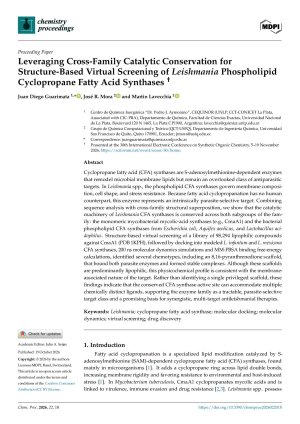
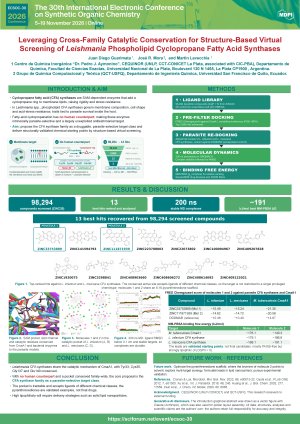
Cyclopropane fatty acid (CFA) synthases are S-adenosylmethionine-dependent enzymes that remodel microbial membrane lipids but remain an overlooked class of antiparasitic targets. In Leishmania spp., the phospholipid CFA synthases govern membrane composition, cell shape, and stress resistance. Because fatty acid cyclopropanation has no human counterpart, this enzyme represents an intrinsically parasite-selective target. Combining sequence analysis with cross-family structural superposition, we show that the catalytic machinery of Leishmania CFA synthases is conserved across both subgroups of the family: the monomeric mycobacterial mycolic-acid synthases (e.g., CmaA1) and the bacterial phospholipid CFA synthases from Escherichia coli, Aquifex aeolicus, and Lactobacillus acidophilus. Structure-based virtual screening of a library of 98,294 lipophilic compounds against CmaA1 (PDB 1KPH), followed by docking into modeled L. infantum and L. mexicana CFA synthases, 200 ns molecular dynamics simulations, and MM-PBSA binding free-energy calculations, identified several chemotypes, including an 8,16-pyranthrenedione scaffold, that bound both parasite enzymes and formed stable complexes. Although these scaffolds are predominantly lipophilic, this physicochemical profile is consistent with the membrane-associated nature of the target. Rather than identifying a single privileged scaffold, these findings indicate that the conserved CFA synthase active site can accommodate multiple chemically distinct ligands, supporting the enzyme family as a tractable, parasite-selective target class and a promising basis for synergistic, multi-target antileishmanial therapies.
Keywords
Leishmania
cyclopropane fatty acid synthase
molecular docking
molecular dynamics
virtual screening
drug discovery
Manuscript
Sciforum-201288 chemproc-22-00018.pdf
Poster
[Sciforum-201288] - [Poster] - [Submission accepted].pdf
Antibacterial Activity of Sequential Organic Extracts from Gliricidia sepium Leaves against Staphylococcus aureus
One-Step Synthesis of a Novel N-Acylmalonamic Acid Ester and Its Potential as an Antiviral Agent