Event submissions
Published
 10.3390/chemproc2026022048 (registering DOI)
This submission belongs to the session Session 2. Chemistry of Bioorganics, Medicinal and Natural Products of the event The 30th International Electronic Conference on Synthetic Organic Chemistry
Published date
02 Nov, 2026
Academic Editor
 Julio A. Seijas
Citation
Mirna Markocevic, Milena Ivkovic, Branislava Tenjović, Milan Ilić, Nataša Jovanović-Lješković, Mire Zloh, Chemoinformatics Mapping of Natural Polyphenols: Integrating Empirical SAR Matrices and Network Pharmacology for Informed Supplement Formulation, in Proceedings of The 30th International Electronic Conference on Synthetic Organic Chemistry, 5 November–19 November 2026, MDPI: Basel, Switzerland, doi: 10.3390/chemproc2026022048
Share
Email
Facebook
Twitter
LinkedIn
Chemoinformatics Mapping of Natural Polyphenols: Integrating Empirical SAR Matrices and Network Pharmacology for Informed Supplement Formulation

Mirna Markocevic 1
Milena Ivkovic 1
Branislava Tenjović 1
Milan Ilić 1
Nataša Jovanović-Lješković 1

Mire Zloh 1,2
1. Faculty of Pharmacy, University Business Academy, Heroja Pinkija 4, 21101 Novi Sad, Serbia
2. UCL School of Pharmacy, University College London, 29/39 Brunswick Square, London WC1N 1AX, UK
Abstract
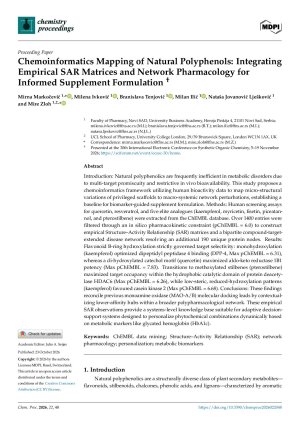
Introduction: Natural polyphenolics are frequently inefficient in metabolic disorders due to multi-target promiscuity and restrictive in vivo bioavailability. This study proposes a chemoinformatics framework utilizing human bioactivity data to map micro-structural variations of privileged scaffolds to macro-systemic network perturbations, establishing a baseline for biomarker-guided supplement formulation.
Methods: Human screening assays for quercetin, resveratrol, and five elite analogues (kaempferol, myricetin, fisetin, piceatannol, pterostilbene) were extracted from the ChEMBL database. Over 1,400 entries were filtered through an in silico pharmacokinetic constraint (pChEMBL = 6.0) to construct empirical Structure-Activity Relationship (SAR) matrices and a bipartite compound-target-extended disease network resolving an additional 190 unique protein nodes.
Results: Flavonoid B-ring hydroxylation strictly governed target selectivity: monohydroxylation (kaempferol) optimized dipeptidyl peptidase 4 binding (DPP-4, Max pChEMBL = 6.31), whereas a di-hydroxylated catechol motif (quercetin) maximized aldo-keto reductase 1B1 potency (Max pChEMBL = 7.83). Transitions to methoxylated stilbenes (pterostilbene) maximized target occupancy within the hydrophobic catalytic domain of protein deacetylase HDAC6 (Max pChEMBL = 6.26), while low-steric, reduced-hydroxylation patterns (kaempferol) favored Casein kinase 2 (Max pChEMBL = 6.68).
Conclusions: These findings reconcile previous monoamine oxidase (MAO-A/B) molecular docking leads by contextualizing lower-affinity hubs within a broader polypharmacological network. These empirical SAR observations provide a systems-level knowledge base suitable for adaptive decision-support systems designed to personalize phytochemical combinations dynamically based on metabolic markers like Glycated Hemoglobin (HbA1c).
Keywords
ChEMBL data mining
Structure-Activity Relationship (SAR)
Network Pharmacology
Personalization
Metabolic Biomarkers
Manuscript
Sciforum-201915.pdf
Engineered PANI/Carbon Dot Hybrids Materials for Advanced Chemiresistive Gas Sensors
Optimization of catalytic synthesis of thetrahydropyridines by multicomponent reaction.