Event submissions
Published
 10.3390/chemproc2026022021 (registering DOI)
This submission belongs to the session Session 1. General Organic Synthesis of the event The 30th International Electronic Conference on Synthetic Organic Chemistry
Published date
02 Nov, 2026
Academic Editor
 Julio A. Seijas
Citation
Didier Villemin, Fathia Zaoui, Nathalie Bar, PEI–silica catalysis under microwave irradiation: solvent-free condensation of dehydroacetic acid with aromatic and heteroaromatic aldehydes, in Proceedings of The 30th International Electronic Conference on Synthetic Organic Chemistry, 5 November–19 November 2026, MDPI: Basel, Switzerland, doi: 10.3390/chemproc2026022021
Share
Email
Facebook
Twitter
LinkedIn
PEI–silica catalysis under microwave irradiation: solvent-free condensation of dehydroacetic acid with aromatic and heteroaromatic aldehydes

Didier Villemin 1
Fathia Zaoui 2
Nathalie Bar 1
1. Institut CARMeN, UMR 6064 CNRS (ex LCMT), ENSICAEN, Univ Caen Normandie, Univ Rouen Normandie, INSA Rouen Normandie, F-14050 Caen, France.
2. Département de Chimie, Faculté des Sciences, Université Dr Moulay Tahar, BP 138 Ennasr, 20000 Saida, Algérie
Abstract
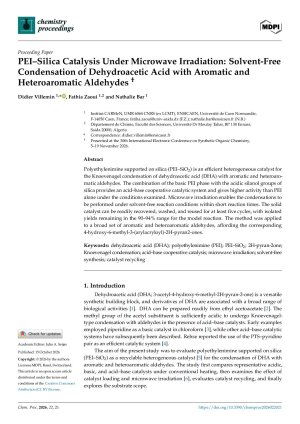
Dehydroacetic acid (DHA; 3-acetyl-4-hydroxy-6-methyl-2H-pyran-2-one) is a versatile synthon, and its derivatives exhibit a variety of biological activities. Building on our previous study showing that polyethyleneimine supported on silica (PEI–silica) is an effective catalyst for Knoevenagel condensations, we report here the condensation of DHA with aromatic and heteroaromatic aldehydes under microwave irradiation in the absence of a solvent. Under these short, energy-efficient conditions, the protocol is in ligne with green chemistry principles, and the solid PEI–silica catalyst can be easily recovered and recycled. Compared with a wide range of Brønsted and Lewis acid–base catalysts, the PEI–silica ranks among the most active, consistent with acid–base cooperativity between the polyethylenimine and silica components. The resulting (E)-4-hydroxy-6-methyl-3-(arylacryloyl)-2H-pyran-2-ones were obtained in good to excellent yields and characterized by 1H/13C NMR, IR, and mass spectrometry.
(1) A. A. Fadda , K. M. Elattar, Synthetic Communications, 2016, 46, 1 1-30; doi:10.1080/00397911.2015.1092549
(2) A. Sharma, Various Biological Activities of DHA Derivatives in the book Useful Synthons in Organic Synthesis, 2017, pp 81-118 ; Chapter 5 , Elsevier ; doi: 10.1016/B978-0-08-101926-9.00005-5
(3) F. Zaoui, D. Villemin, N. Bar, M. A. Didi, Sc. Stud. Res. Chem. Chem. Eng., Biotech., 2017, 18 (1) 1-8 ISSN 1582-540X. https://hal.science/hal-01829083
(4) A. Ben Alloum, B. Labiad, D. Villemin, Application of microwave heating techniques for dry organic reactions. J. Chem. Soc. Chem. Commun., 1989, 386-387; doi: 10.1039/C39890000386.
Keywords
dehydroacetic acid (DHA)
PEI–silica
2H-pyran-2-one
green chemistry
acid–base cooperative catalysis
microwave irradiation
solvent-free
recycling
Manuscript
Sciforum-202386 chemproc-22-00021.pdf
Optimization of catalytic synthesis of thetrahydropyridines by multicomponent reaction.
Synthesis of a Chlorophyllin–Chitosan Conjugate with Potential Application as a Photosensitizer