Event submissions
Published
 10.3390/chemproc2026022050 (registering DOI)
This submission belongs to the session Session 2. Chemistry of Bioorganics, Medicinal and Natural Products of the event The 30th International Electronic Conference on Synthetic Organic Chemistry
Published date
02 Nov, 2026
Academic Editor
 Julio A. Seijas
Citation
Malena Luana Boffadossi, Giuliana Larrea, Edgardo Nestor Durantini, María Elisa Milanesio, Synthesis of a Chlorophyllin–Chitosan Conjugate with Potential Application as a Photosensitizer, in Proceedings of The 30th International Electronic Conference on Synthetic Organic Chemistry, 5 November–19 November 2026, MDPI: Basel, Switzerland, doi: 10.3390/chemproc2026022050
Share
Email
Facebook
Twitter
LinkedIn
Synthesis of a Chlorophyllin–Chitosan Conjugate with Potential Application as a Photosensitizer

Malena Luana Boffadossi 1
Giuliana Larrea 1
Edgardo Nestor Durantini 1,2
María Elisa Milanesio 1,2
1. Instituto para el Desarrollo Agroindustrial y de la Salud (IDAS), Consejo Nacional de Investigaciones Científicas y Técnicas (CONICET), Ruta Nacional 36 Km 601, X5804BYA Río Cuarto, Córdoba, Argentina.
2. Departamento de Química, Facultad de Ciencias Exactas, Físico-Químicas y Naturales, Universidad Nacional de Río Cuarto, Ruta Nacional 36 Km 601, X5804BYA Río Cuarto, Córdoba, Argentina.
Abstract
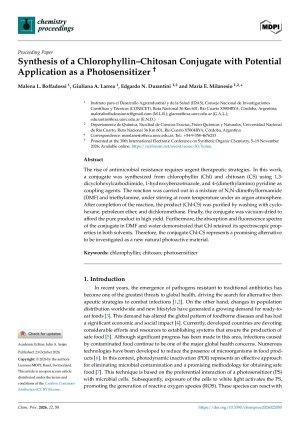
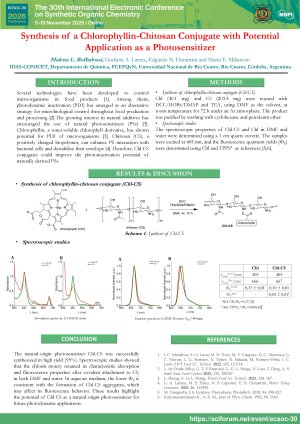
Chlorophyllin (Chl) is a chlorophyll derivative with a high capacity to absorb radiation in the visible region of the electromagnetic spectrum. This property, together with its ability to generate reactive oxygen species, enables it to act as an efficient photosensitizer. Although it is a natural and biocompatible compound, its solubility is limited, particularly in polar or aqueous media. On the other hand, chitosan (CS) is a biopolymer characterized by its biodegradability, biocompatibility, non-toxicity, and high density of amino and hydroxyl groups, which facilitate its chemical modification and the covalent attachment of various functional molecules. Considering these properties, the covalent conjugation of Chl to CS enables the development of a hybrid material that combines the photosensitizing properties of Chl with the structural and functional advantages of CS.
In this work, a Chl-CS conjugate was synthesized from Chl (40 mg) and CS (200 mg) using 1,3-dicyclohexylcarbodiimide, 1-hydroxybenzotriazole, and 4-(dimethylamino) pyridine as coupling agents. The reaction was carried out in a mixture of N,N-dimethylformamide (DMF) and triethylamine, under stirring for 72 h at room temperature under an argon atmosphere. After completion of the reaction, the solid product was purified by washing with cyclohexane, petroleum ether, and dichloromethane. Finally, Chl-CS was vacuum-dried to afford the pure product in high yield. Furthermore, the absorption and fluorescence spectra of the conjugate in DMF and water demonstrated that Chl retained its spectroscopic properties in both solvents. Therefore, the conjugate Chl-CS represents a promising alternative to be investigated as a new natural photoactive material.
Keywords
Chlorophyllin
Chitosan
Photosensitizer
Manuscript
Sciforum-202339.pdf
Poster
[Sciforum-202339] - [Poster] - [Submission accepted].pdf
PEI–silica catalysis under microwave irradiation: solvent-free condensation of dehydroacetic acid with aromatic and heteroaromatic aldehydes
Discovery of Bioactive compounds from Syzygium cumini L. Targeting PI3Kɑ for Breast Cancer Therapy: An Integrated Computational Approach