Event submissions
Published
 10.3390/chemproc2026022022 (registering DOI)
This submission belongs to the session Session 1. General Organic Synthesis of the event The 30th International Electronic Conference on Synthetic Organic Chemistry
Published date
02 Nov, 2026
Academic Editor
 Julio A. Seijas
Contribution&Funding
Conceptualization,
[Stephen Paul Wren] ; [Nathan Long]
Methodology,
[Nathan Long]
Software,
[Joseph Bear]
Validation,
[Stephen Paul Wren]
Formal analysis,
[Nathan Long] ; [Jeremy Karl Cockcroft]
Investigation,
[Nathan Long] ; [Joseph Bear]
Data curation,
[Joseph Bear] ; [Jeremy Karl Cockcroft]
Writing - original draft,
[Nathan Long] ; [Jeremy Karl Cockcroft]
Writing - review,
[editing] ; [Stephen Paul Wren] ; [Jeremy Karl Cockcroft]
Supervision,
[Jeremy Karl Cockcroft] ; [Joseph Bear] ; [Stephen Paul Wren]
Project administration,
[Stephen Paul Wren]
Funding: --
Citation
Nathan Long, Stephen Paul Wren, Joseph Bear, Jeremy Karl Cockcroft, The Missing Corners of the Square: ¹³C NMR Challenges in Monosquarate-Amides, in Proceedings of The 30th International Electronic Conference on Synthetic Organic Chemistry, 5 November–19 November 2026, MDPI: Basel, Switzerland, doi: 10.3390/chemproc2026022022
Share
Email
Facebook
Twitter
LinkedIn
The Missing Corners of the Square: 13C NMR Challenges in Monosquarate-Amides

Nathan Long 1

Stephen Paul Wren 1
Joseph Bear 1
Jeremy Karl Cockcroft 2
1. Department of Pharmacy and Chemistry, Kingston University London, London, KT12EE, UK
2. Department of Chemistry, University College London, London, WC1H0AJ, UK
Abstract
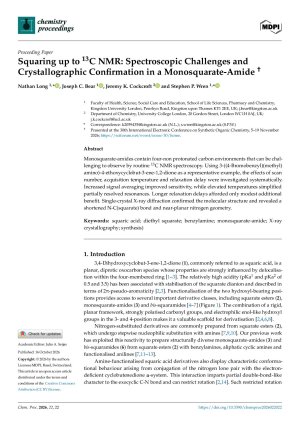
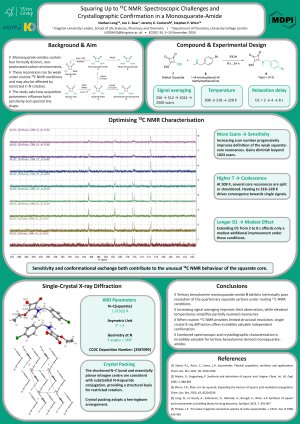
Squaric acid, 3,4-dihydroxycyclobut-3-ene-1,2-dione, is a highly functionalised and electron-deficient four-membered carbocycle that provides a versatile platform for the preparation of structurally diverse derivatives. Conversion of squaric acid to squarate esters provides readily functionalised intermediates that undergo facile substitution with amines, enabling access to monosquarate-amides and bis-squaramides. These compound classes have attracted interest across synthetic, medicinal and supramolecular chemistry. Despite their relatively simple structural motifs, however, complete characterisation by routine 13C NMR spectroscopy can sometimes prove challenging, particularly for the quaternary carbon atoms of the core squaric acid ring.
In this study, the 13C NMR characterisation of representative monosquarate-amides is investigated using modified acquisition parameters designed to improve the detection and resolution of weak or poorly observed resonances. Particular attention is given to 3-((4-bromobenzyl)(methyl)amino)-4-ethoxycyclobut-3-ene-1,2-dione (1), a tertiary benzylamine-derived monosquarate-amide, for which conventional 13C NMR analysis provides limited resolution of the squarate carbon environments. Extended acquisition experiments are compared with routine spectra to assess the extent to which altered acquisition conditions can improve structural characterisation. A related aniline-derived monosquarate-amide is additionally examined as a comparative example.
To provide complementary structural confirmation, the previously undisclosed single-crystal X-ray diffraction structure of 1 is also presented. Together, these results highlight practical considerations in the 13C NMR analysis of monosquarate-amides and demonstrate the value of combining optimised spectroscopic methods with crystallographic characterisation where routine NMR data alone may be incomplete.
Keywords
NMR
Squaric Acid
Medicinal Chemistry
Single-crystal
Synthesis
Squarate
Squaramide
Manuscript
Sciforum-210798 chemproc-22-00022.pdf
Poster
[Sciforum-210798] - [Poster] - [Submission accepted].pdf
Discovery of Bioactive compounds from Syzygium cumini L. Targeting PI3Kɑ for Breast Cancer Therapy: An Integrated Computational Approach
Development, Validation, and Application of a Structure-Based Pharmacophore Model for Human Dihydrofolate Reductase Inhibitor Discovery through Drug Repurposing