Event submissions
Published
 10.3390/chemproc2026022023 (registering DOI)
This submission belongs to the session Session 2. Chemistry of Bioorganics, Medicinal and Natural Products of the event The 30th International Electronic Conference on Synthetic Organic Chemistry
Published date
02 Nov, 2026
Academic Editor
 Julio A. Seijas
Citation
Ibrahim Maattallaoui, Noureddine El Aouad, Development, Validation, and Application of a Structure-Based Pharmacophore Model for Human Dihydrofolate Reductase Inhibitor Discovery through Drug Repurposing, in Proceedings of The 30th International Electronic Conference on Synthetic Organic Chemistry, 5 November–19 November 2026, MDPI: Basel, Switzerland, doi: 10.3390/chemproc2026022023
Share
Email
Facebook
Twitter
LinkedIn
Development, Validation, and Application of a Structure-Based Pharmacophore Model for Human Dihydrofolate Reductase Inhibitor Discovery through Drug Repurposing

Ibrahim Maattallaoui 1

Noureddine El Aouad 1
1. Laboratory of Life and Health Sciences, Faculty of medicine and Pharmacy of tangier, road of rabat 15km Gzenaya BP 365 Tangier, Abdelmalek Essaadi University, Tetouan 92000, Morocco
Abstract
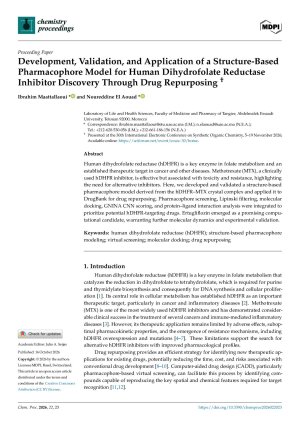
Introduction: Human dihydrofolate reductase (hDHFR) is a key enzyme in folate metabolism and an established therapeutic target for cancer and autoimmune diseases. Although methotrexate remains the reference hDHFR inhibitor, its clinical use is limited by toxicity and the emergence of drug resistance. Drug repurposing, which explores new therapeutic uses for existing compounds, offers a cost-effective alternative for identifying hDHFR inhibitors with established safety profiles.
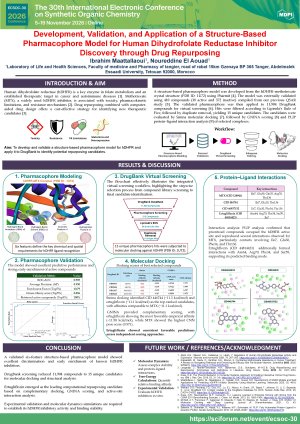
Methods: A structure-based pharmacophore model was generated from the crystal structure of the hDHFR–MTX complex (PDB ID: 1U72). The model was validated using an external dataset of 410 compounds and assessed through receiver operating characteristic (ROC) analysis, average precision, enrichment factor, and Güner–Henry scoring. The validated pharmacophore was subsequently applied to virtual screening of the DrugBank database to identify approved and investigational drugs with potential hDHFR inhibitory activity.
Results: The pharmacophore model demonstrated excellent predictive performance, achieving a ROC-AUC of 0.989, an average precision of 0.95, an enrichment factor of 10.53, and a Güner–Henry score of 0.882. Virtual screening identified compounds that satisfied the pharmacophoric requirements and were prioritized according to their predicted binding potential and drug repurposing relevance. Subsequent molecular docking estimated binding energies ranging from −7.0 to −11.1 kcal/mol. Importantly, the workflow successfully recovered previously reported DHFR inhibitors, supporting the reliability of the screening strategy while identifying promising candidates.
Conclusions: Overall, the results demonstrate that structure-based pharmacophore modeling combined with virtual screening and molecular docking constitutes an efficient strategy for hDHFR inhibitor discovery through drug repurposing. The prioritized compounds represent promising candidates for subsequent molecular dynamics simulations and experimental validation.
Keywords
Human dihydrofolate reductase (hDHFR)
Structure-based pharmacophore modeling
Virtual screening
Molecular docking
Drug repurposing
Manuscript
Sciforum-202023 chemproc-22-00023.pdf
Poster
[Sciforum-202023] - [Poster] - [Submission accepted].pdf
The Missing Corners of the Square: 13C NMR Challenges in Monosquarate-Amides
A Three-Step Synthesis of 4-Hydroxy-2H-benzo[g]chromen-2-one from Beta-Naphthol