Event submissions
Published
 10.3390/chemproc2026022052 (registering DOI)
This submission belongs to the session Session 2. Chemistry of Bioorganics, Medicinal and Natural Products of the event The 30th International Electronic Conference on Synthetic Organic Chemistry
Published date
02 Nov, 2026
Academic Editor
 Julio A. Seijas
Citation
Humphrey Masimba Makumbirofa, Pholani Maphosa, Fadila Benali, Adil Ali Othman, A Three-Step Synthesis of 4-Hydroxy-2H-benzo[g]chromen-2-one from Beta-Naphthol, in Proceedings of The 30th International Electronic Conference on Synthetic Organic Chemistry, 5 November–19 November 2026, MDPI: Basel, Switzerland, doi: 10.3390/chemproc2026022052
Share
Email
Facebook
Twitter
LinkedIn
A Three-Step Synthesis of 4-Hydroxy-2H-benzo[g]chromen-2-one from Beta-Naphthol

Humphrey Masimba Makumbirofa 1

Pholani Maphosa 2
Fadila Benali 3
Adil Ali Othman 4
1. Department of Pharmaceutical Technology, School of Allied Health Sciences, Harare Institute of Technology, Belvedere, Harare, Zimbabwe
2. Beacon of Life Institute, Bulawayo, Zimbabwe
3. Department of Industrial Chemistry, Faculty of Chemistry, University of Science and Technology of Oran-USTO- MB, Oran, ALGERIA
4. Numedian Chemistry Science and Technology (NCST), Oran, Algeria
Abstract
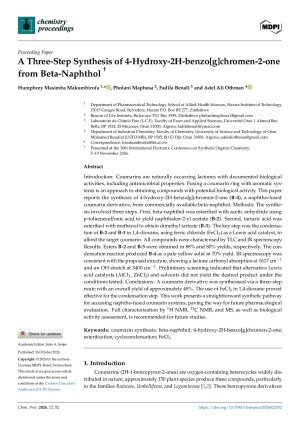
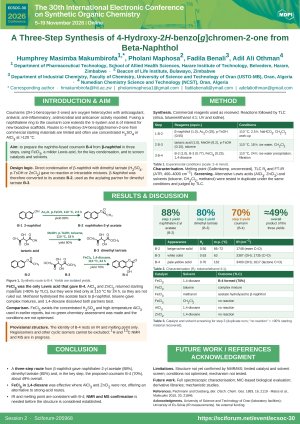
Introduction: Coumarins are naturally occurring lactones with documented biological activities, including antimicrobial properties. The fusion of a coumarin ring with aromatic systems represents an approach for obtaining compounds with potential biological activity. This paper reports the synthesis of 4-hydroxy-2H-benzo[g]chromen-2-one (B-4), a naphtho-fused coumarin derivative, from commercially available beta-naphthol.
Methods: The synthesis involved three steps. First, beta-naphthol was esterified with acetic anhydride using p-toluenesulfonic acid to yield naphthalen-2-yl acetate (B-2). Second, tartaric acid was esterified with methanol to obtain dimethyl tartrate (B-3). The key step was condensation of B-2 and B-3 using ferric chloride (FeCl₃) as a Lewis acid catalyst in 1,4-dioxane to afford the target coumarin. All compounds were characterised by TLC and IR spectroscopy.
Results: Esters B-2 and B-3 were obtained in 88% and 80% yields, respectively. The condensation reaction produced B-4 as a pale yellow solid in 70% yield. IR spectroscopy was consistent with the proposed structure, showing a lactone carbonyl absorption at 1617 cm⁻¹ and an OH stretch at 3400 cm⁻¹. Preliminary screening indicated that alternative Lewis acid catalysts (AlCl₃, ZnCl₂) and solvents did not yield the desired product under the conditions tested.
Conclusions: A coumarin derivative was synthesised via a three-step route with an overall yield of approximately 49%. The use of FeCl₃ in 1,4-dioxane proved effective for the condensation step. This work presents a straightforward synthetic pathway for accessing naphtho-fused coumarin systems, paving the way for future pharmacological evaluation. Full characterisation by ¹H NMR, ¹³C NMR, and MS, as well as biological activity assessment, recommended for future studies.
Keywords
coumarin synthesis
beta-naphthol
4-hydroxy-2H-benzo[g]chromen-2-one
esterification
cyclocondensation
FeCl₃
Manuscript
Sciforum-205968.pdf
Poster
Benzochromenone Synthesis Poster.pdf
Development, Validation, and Application of a Structure-Based Pharmacophore Model for Human Dihydrofolate Reductase Inhibitor Discovery through Drug Repurposing
The Dipole Climbs, S₁ Barely Budges: Solvent-Resolved DFT and TD-DFT of an Alanine-Derived 4-Hydroxypyrrole