Event submissions
Published
 10.3390/chemproc2026022053 (registering DOI)
This submission belongs to the session Session 2. Chemistry of Bioorganics, Medicinal and Natural Products of the event The 30th International Electronic Conference on Synthetic Organic Chemistry
Published date
02 Nov, 2026
Academic Editor
 Julio A. Seijas
Citation
Sarra GHALEM, Imane ABDELLI, Faiçal HASSANI, Yamina Houas, Yazid DATOUSSAID, Floristic characterization of the plant community associated with Agave americana and in silico evaluation of its bioactive compounds, in Proceedings of The 30th International Electronic Conference on Synthetic Organic Chemistry, 5 November–19 November 2026, MDPI: Basel, Switzerland, doi: 10.3390/chemproc2026022053
Share
Email
Facebook
Twitter
LinkedIn
Floristic characterization of the plant community associated with Agave americana and in silico evaluation of its bioactive compounds

Sarra GHALEM 1
Imane ABDELLI 1,2,3
Faiçal HASSANI 1
Yamina Houas 1
Yazid DATOUSSAID 2,4
1. Ecology and Management of Naturals Ecosystems Laboratory, Department of Ecology and Environment, Faculty SNV-STU, University of Tlemcen, Tlemcen, Algeria
2. Ecole Supérieure en Sciences Appliquées, ESSA-Tlemcen, BP 165 RP Bel Horizon, Tlemcen 13000, Algeria
3. Laboratory of Natural and Bio-actives Substances, Faculty of Science, University of Tlemcen, Tlemcen, Algeria
4. Laboratoire de Catalyse et Synthèse en Chimie Organique, Faculté des Sciences, University of Tlemcen, BP 119, Tlemcen, 13000, Algeria
Abstract
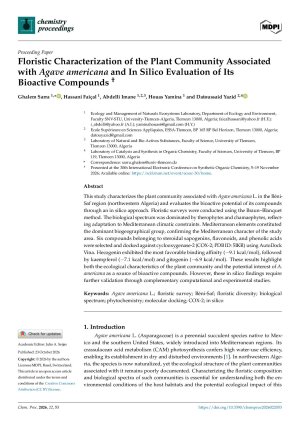
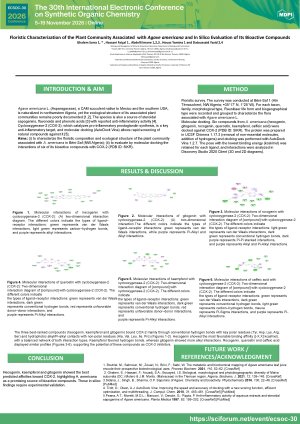
This study focuses on the floristic characterization of the plant community associated with Agave americana L. (Asparagaceae), an exotic succulent species established in the Béni-Saf region (Aïn Témouchent, Algeria), and briefly discusses its potential for chemical valorization through future in silico approaches.
Phytosociological surveys were carried out using the Braun-Blanquet method, based on 50 relevés covering an area of approximately 10 km². For each identified species, the botanical family, biological type (Raunkiaer classification), morphological type, and biogeographic origin were recorded. The results showed a flora dominated by Asteraceae (16.92%), Lamiaceae (10.76%), and Poaceae (9.23%). The biological spectrum was characterized by a clear dominance of therophytes (47.69%), followed by chamaephytes (26.15%) and hemicryptophytes (13.84%), indicating an open and disturbed environment subject to strong water constraints. Phanerophytes were poorly represented (3.07%), reflecting a regression of woody cover associated with anthropogenic pressures such as grazing, clearing, and erosion. Biogeographically, Mediterranean elements predominated (42.85%), confirming the thermo-Mediterranean character of the study area.
Agave americana, with its CAM metabolism, high colonization capacity, and monocarpic life cycle, appears well adapted to these arid conditions. Its presence does not yet appear to significantly disrupt the local ecological balance; however, its competitive potential warrants continued monitoring.
Beyond its ecological significance, this species is of particular interest because of its chemical composition and the presence of bioactive compounds associated with recognized anti-inflammatory, wound-healing, and antidiabetic properties. In this context, future in silico investigations could be undertaken to further explore the therapeutic potential of its secondary metabolites.
Keywords
Agave americana
floristic survey
Béni-Saf
biological spectrum
in silico
phytochemistry.
Manuscript
Sciforum-204696.pdf
Poster
Sciforum-204696.pdf
The Dipole Climbs, S₁ Barely Budges: Solvent-Resolved DFT and TD-DFT of an Alanine-Derived 4-Hydroxypyrrole
Exploring Natural Compounds as Inhibitors Against DNA-directed RNA Polymerase in Possible Allosteric Sites Employing in silico Strategies