Event submissions
Published
 10.3390/chemproc2026022055 (registering DOI)
This submission belongs to the session Session 3. Design and Application of Organic/Supramolecular Assemblies of the event The 30th International Electronic Conference on Synthetic Organic Chemistry
Published date
02 Nov, 2026
Academic Editor
 Julio A. Seijas
Contribution&Funding
Conceptualization,
[Sinisa Popov] ; [Jinwen Zeng] ; [Mire Zloh] ; [Paul A. Dalby] ; [Steve Brocchini]
Methodology,
[Mire Zloh] ; [Steve Brocchini] ; [Teresa Barata] ; [Paul A. Dalby]
Software,
[Mire Zloh]
Validation,
[Mire Zloh] ; [Steve Brocchini]
Formal analysis,
[Sinisa Popov] ; [Mire Zloh] ; [Jinwen Zeng]
Investigation,
[Jinwen Zeng] ; [Mire Zloh] ; [Sinisa Popov]
Resources,
[Paul A. Dalby] ; [Jinwen Zeng] ; [Mire Zloh] ; [Sinisa Popov]
Data curation,
[Mire Zloh]
Writing - original draft,
[Jinwen Zeng] ; [Sinisa Popov]
Writing - review,
[editing] ; [Natasa Jovanovic Ljeskovic] ; [Mire Zloh]
Visualization,
[Mire Zloh]
Supervision,
[Natasa Jovanovic Ljeskovic] ; [Mire Zloh]
Project administration,
[Mire Zloh]
Funding: --
Citation
Sinisa Popov, Jinwen Zeng, Teresa Barata, Paul A. Dalby, Steve Brocchini, Natasa Jovanovic Ljeskovic, Mire Zloh, A Molecular Dynamics Study of β-Cyclodextrin Inclusion of Glucagon During Simulated Freeze-Drying and Reconstitution, in Proceedings of The 30th International Electronic Conference on Synthetic Organic Chemistry, 5 November–19 November 2026, MDPI: Basel, Switzerland, doi: 10.3390/chemproc2026022055
Share
Email
Facebook
Twitter
LinkedIn
A Molecular Dynamics Study of β-Cyclodextrin Inclusion of Glucagon During Simulated Freeze-Drying and Reconstitution

Sinisa Popov 1
Jinwen Zeng 2
Teresa Barata 2
Paul A. Dalby 3
Steve Brocchini 2
Natasa Jovanovic Ljeskovic 1

Mire Zloh 1,2
1. Department of Pharmacy, Faculty of Pharmacy Novi Sad, University Business Academy, Novi Sad, 21000, Serbia
2. School of Pharmacy, University College London - UCL , London, UK
3. Department of Biochemical Engineering, University College London - UCL , London, UK
Abstract
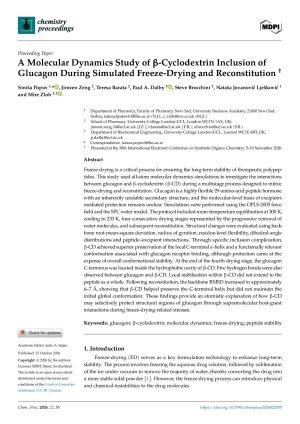
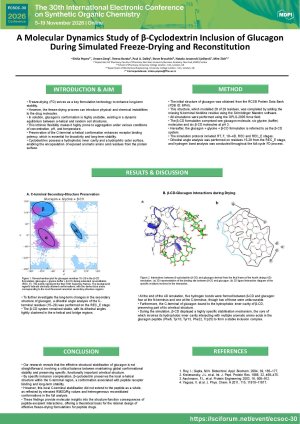
Freeze-drying is a critical process for ensuring the long-term stability of therapeutic peptides. This study used all-atom molecular dynamics simulations to investigate the interactions between glucagon and β-cyclodextrin (β-CD) during a multistage process designed to mimic freeze-drying and reconstitution. Glucagon is a highly flexible 29-amino-acid peptide hormone with an inherently unstable secondary structure, and the molecular-level basis of excipient-mediated protection remains unclear. Simulations were performed using the OPLS-2005 force field and the SPC water model. The protocol included room-temperature equilibration at 300 K, cooling to 233 K, four consecutive drying stages represented by the progressive removal of water molecules, and subsequent reconstitution. Structural changes were evaluated using backbone root-mean-square deviation, radius of gyration, residue-level flexibility, dihedral-angle distributions and peptide–excipient interactions. Through specific inclusion complexation, β-CD achieved superior preservation of the local C-terminal α-helix, a functionally relevant conformation associated with glucagon receptor binding, but this targeted protection came at the expense of overall conformational stability. At the end of the fourth drying stage, the glucagon C-terminus was located inside the hydrophobic cavity of β-CD. Five hydrogen bonds were also observed between glucagon and β-CD. This local stabilisation did not extend to the peptide as a whole. Following reconstitution, the backbone RMSD increased to approximately 6–7 Å, showing that β-CD helped preserve the C-terminal helix but did not maintain the initial global conformation. These findings provide an atomistic explanation of how β-CD may selectively protect structural regions of glucagon through supramolecular host–guest interactions during freeze-drying-related stresses.
Keywords
glucagon
β-cyclodextrin
molecular dynamics
freeze-drying
peptide stability
Manuscript
Sciforum-207679.pdf
Poster
[Sciforum-207679] - [Poster] - [Submission accepted].pdf
Exploring Natural Compounds as Inhibitors Against DNA-directed RNA Polymerase in Possible Allosteric Sites Employing in silico Strategies
Electrochemical Evaluation of Coordination Polymers as Efficient Corrosion Inhibitors for Iron in Aggressive Media