Event submissions
Published
 10.3390/chemproc2026022057 (registering DOI)
This submission belongs to the session Session 2. Chemistry of Bioorganics, Medicinal and Natural Products of the event The 30th International Electronic Conference on Synthetic Organic Chemistry
Published date
02 Nov, 2026
Academic Editor
 Julio A. Seijas
Citation
Maria Sousa, Dina Maciel, Jorge A.M. Pereira, João Rodrigues, Pedro Pires, Ruilong Sheng, Synthesis, Characterization, and in silico Analysis of Cholesterol–Hydrazone Conjugates as Prodrug Models, in Proceedings of The 30th International Electronic Conference on Synthetic Organic Chemistry, 5 November–19 November 2026, MDPI: Basel, Switzerland, doi: 10.3390/chemproc2026022057
Share
Email
Facebook
Twitter
LinkedIn
Synthesis, Characterization, and in silico Analysis of Cholesterol–Hydrazone Conjugates as Prodrug Models

Maria Sousa 1
Dina Maciel 1
Jorge A.M. Pereira 1

João Rodrigues 1
Pedro Pires 1
Ruilong Sheng 1
1. CQM Centro de Química da Madeira, Universidade da Madeira, Campus da Penteada, 9000 390 Funchal, Portugal
Abstract
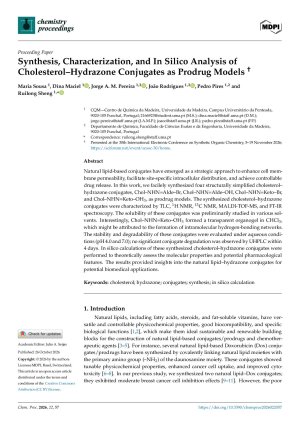
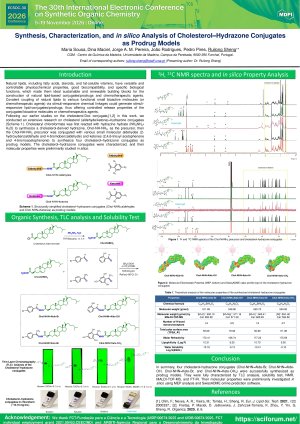
Natural lipid-based conjugates have emerged as a strategic approach to enhance cell membrane permeability, site-specific intracellular distribution, and achieve controllable drug release. In previous studies, we prepared several lipid-based conjugates with poorly-biodegradable carbamate linkages. Herein, we replaced the carbamate with pH-responsive hydrazone linkages to explore the molecular properties and potential pH-responsive prodrug release behaviour. Accordingly, by reacting a cholesterol–hydrazine intermediate (Chol-NHNH2) with simple aldehydes and ketones, we facilely synthesized four structurally simplified cholesterol–hydrazone conjugates (Chol–NHN=Alde–Br, Chol–NHN=Alde–OH, Chol–NHN=Keto–Br, and Chol–NHN=Keto–OH₃) as prodrug models. The purity and polarity of the synthesized conjugates was assessed by TLC, and their structures were fully characterized and confirmed by TLC, FT-IR, ¹H NMR, ¹³C NMR, and MALDI-TOF-MS. Their solubility was preliminarily investigated in various solvents. Interestingly, Chol–NHN=Keto–OH₃ formed a transparent organogel in CHCl₃, which might be attributed to the formation of intermolecular hydrogen-bonding networks. An UHPLC method was employed to evaluate the stability and degradability of these cholesterol–hydrazone conjugates under aqueous conditions (pH 4.0 and 7.0, in a THF/CH₃CN/H₂O mixture); while no significant conjugate degradation was observed by UHPLC within 4 days. Finally, in silico calculations were performed to virtually assess the molecular properties and potential pharmacological features of the cholesterol–hydrazone conjugates. The results provided insights on the natural lipid-hydrazone conjugates for potential biomedical applications.
Keywords
Prodrug models
cholesterol
Lipid-hydrazine conjugates
degradation
in silico calculation
Manuscript
Sciforum-171054.pdf
Poster
[Sciforum-171054] - [Poster] - [Submission accepted].pdf
Four-Component Ugi-Azide Synthesis of Furan-Based 1,5-Disubstituted Tetrazoles
Synthesis of 1,2,4-thiadiazole derivatives by oxidation of 2-cyanothioacrylamides with dioxane dibromide