Event submissions
Published
 10.3390/chemproc2026022058 (registering DOI)
This submission belongs to the session Session 3. Design and Application of Organic/Supramolecular Assemblies of the event The 30th International Electronic Conference on Synthetic Organic Chemistry
Published date
02 Nov, 2026
Academic Editor
 Julio A. Seijas
Citation
Carolina del Pilar Urquiza, Maribel López, María Eugenia Pérez, María Elisa Milanesio, Edgardo Néstor Durantini, Synthesis of BODIPY-Loaded ZIF-8 Nanomaterials with Enhanced Fluorescent and Photodynamic Properties, in Proceedings of The 30th International Electronic Conference on Synthetic Organic Chemistry, 5 November–19 November 2026, MDPI: Basel, Switzerland, doi: 10.3390/chemproc2026022058
Share
Email
Facebook
Twitter
LinkedIn
Synthesis of BODIPY-Loaded ZIF-8 Nanomaterials with Enhanced Fluorescent and Photodynamic Properties

Carolina del Pilar Urquiza 1

Maribel López 1
María Eugenia Pérez 1
María Elisa Milanesio 1,2
Edgardo Néstor Durantini 1,2
1. Instituto para el Desarrollo Agroindustrial y de la Salud (IDAS), Consejo Nacional de Investigaciones Cien-tíficas y Técnicas (CONICET), Ruta Nacional 36 Km 601, X5804BYA Río Cuarto, Córdoba, Argentina
2. Departamento de Química, Facultad de Ciencias Exactas, Físico-Químicas y Naturales, Universidad Nacional de Río Cuarto, Ruta Nacional 36 Km 601, X5804BYA Río Cuarto, Córdoba, Argentina.
Abstract
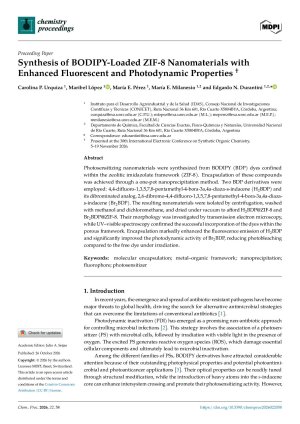
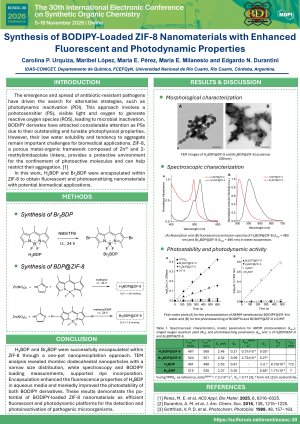
The increasing prevalence of antibiotic-resistant pathogens has intensified the need for advanced photodynamic materials capable of selectively targeting microbial cells. In this work, we report the synthesis and characterization of a series of photosensitizing nanomaterials based on BODIPY (BDP) dyes encapsulated within the metal–organic framework ZIF-8. Two BDP derivatives were employed: 4,4-difluoro-1,3,5,7,8-pentamethyl-4-bora-3a,4a-diaza-s-indacene (H2BDP) and its dibrominated analogue, 2,6-dibromo-4,4-difluoro-1,3,5,7,8-pentamethyl-4-bora-3a,4a-diaza-s-indacene (Br₂BDP). The latter was synthesized by bromination of H2BDP with N-bromosuccinimide in (trifluoromethyl)benzene, affording Br2BDP in 97% yield. Encapsulation of H2BDP and Br2BDP into ZIF-8 was achieved through a one-pot nanoprecipitation method. To maximize dye incorporation, the BDP derivatives were introduced at the initial stage of ZIF-8 formation by slowly adding a solution of zinc nitrate and BDP to a methanolic solution of 2-methylimidazole. The resulting nanomaterials were isolated by centrifugation, washed with methanol and dichloromethane, and dried under vacuum to afford H2BDP@ZIF-8 and Br2BDP@ZIF-8. Their morphology was investigated by transmission electron microscopy (TEM), whileUV–visible spectroscopy confirmed the successful incorporation of the dyes within the porous framework. Encapsulation markedly enhanced the fluorescence emission ofH₂BDP in aqueous media and significantly improved the photostability of Br₂BDP, reducing photobleaching compared to the free dye under irradiation. These results demonstrate the potential of BDP-loadedZIF-8 nanomaterials as efficient fluorescent and photodynamic platforms for the detection and photoinactivation of pathogenic microorganisms.
Keywords
BODIPY
ZIF-8
metal–organic frameworks
nanomaterial.
Manuscript
Sciforum-201471.pdf
Poster
[Sciforum-201471] - [Poster] - [Submission accepted].pdf
Synthesis of 1,2,4-thiadiazole derivatives by oxidation of 2-cyanothioacrylamides with dioxane dibromide
Harnessing Supramolecular Chemistry for Gene Therapy: Cyclodextrin-Based Platforms for Nucleic Acid Delivery