Event submissions
Published
 10.3390/chemproc2026022024 (registering DOI)
This submission belongs to the session Session 3. Design and Application of Organic/Supramolecular Assemblies of the event The 30th International Electronic Conference on Synthetic Organic Chemistry
Published date
02 Nov, 2026
Academic Editor
 Julio A. Seijas
Citation
Ilaria D'Agostino, Giovanni Petrarolo, Bianca Laura Bernardoni, Lorenzo Germelli, Francesca Corsi, Laura Marchetti, Ilaria Piano, Maria Cristina Gamberini, Chiara Giacomelli, Maria Claudia Gargini, Claudia Martini, Concettina La Motta, Harnessing Supramolecular Chemistry for Gene Therapy: Cyclodextrin-Based Platforms for Nucleic Acid Delivery, in Proceedings of The 30th International Electronic Conference on Synthetic Organic Chemistry, 5 November–19 November 2026, MDPI: Basel, Switzerland, doi: 10.3390/chemproc2026022024
Share
Email
Facebook
Twitter
LinkedIn
Harnessing Supramolecular Chemistry for Gene Therapy: Cyclodextrin-Based Platforms for Nucleic Acid Delivery

Ilaria D'Agostino 1

Giovanni Petrarolo 1

Bianca Laura Bernardoni 1

Lorenzo Germelli 1
Francesca Corsi 1
Laura Marchetti 1

Ilaria Piano 1
Maria Cristina Gamberini 2
Chiara Giacomelli 1
Maria Claudia Gargini 1

Claudia Martini 1

Concettina La Motta 1
1. Department of Pharmacy, University of Pisa, Via Bonanno 6, 56126 Pisa, Italy
2. Department of Life Sciences, University of Modena and Reggio Emilia, Via Giuseppe Campi 103, 41125 Modena, Italy
Abstract
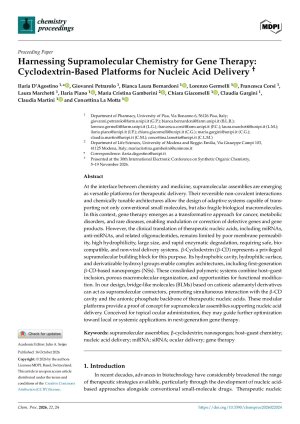
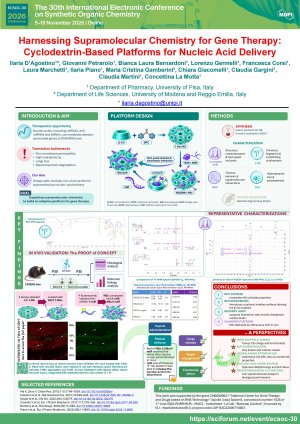
At the interface between chemistry and medicine, supramolecular assemblies are emerging as versatile platforms for therapeutic delivery. Their reversible non-covalent interactions and chemically tunable architectures allow the design of adaptive systems capable of transporting not only conventional small molecules, but also fragile biological macromolecules.1
In this context, gene therapy is emerging as a transformative approach for cancer, metabolic disorders, and rare diseases, enabling modulation or correction of defective genes and gene products.2 However, the clinical translation of therapeutic nucleic acids, including miRNAs, anti-miRNAs, and related oligonucleotides, remains limited by poor membrane permeability, high hydrophilicity, large size, and rapid enzymatic degradation, requiring safe, biocompatible, and non-viral delivery systems.3
β-Cyclodextrin (β-CD) represents a privileged supramolecular building block for this purpose. Its hydrophobic cavity, hydrophilic surface, and derivatizable hydroxyl groups enable complex architectures, including first-generation β-CD-based nanosponges (NS). These crosslinked polymeric systems combine host-guest inclusion, porous macromolecular organization, and opportunities for functional modification. In our design, bridge-like molecules (BLMs) based on cationic adamantyl derivatives can act as supramolecular connectors, promoting simultaneous interaction with the β-CD cavity and the anionic phosphate backbone of therapeutic nucleic acids.4
These modular platforms provide a proof of concept for supramolecular assemblies supporting nucleic acid delivery. Conceived for topical ocular administration, they may guide further optimization toward local or systemic applications in next-generation gene therapy.
This work was funded by the European Union – NextGenerationEU, Mission 4 Component 2, CUP I53C22000710007.
Keywords
nanosponges
Manuscript
Sciforum-202383 chemproc-22-00024.pdf
Poster
Revised Poster ECSOC2026_DAgostino.pdf
Synthesis of BODIPY-Loaded ZIF-8 Nanomaterials with Enhanced Fluorescent and Photodynamic Properties
Silver-Catalyzed Regioselective Synthesis of Benzo[b][1,7]naphthyridin-1(2H)-ones through a Water-Assisted Cascade Cyclization