Event submissions
Published
 10.3390/chemproc2026022028 (registering DOI)
This submission belongs to the session Session 2. Chemistry of Bioorganics, Medicinal and Natural Products of the event The 30th International Electronic Conference on Synthetic Organic Chemistry
Published date
02 Nov, 2026
Academic Editor
 Julio A. Seijas
Citation
Giselle Muñoz-Freire, Johana Zúñiga-Miranda, Juan Carlos Romero-Benavides, Jorge Heredia-Moya, Synthesis, Characterization, and Biological Evaluation of 1-(2-oxo-2H-1-benzopyran-4-yl)-1H-1,2,3-triazole-4-carbaldehyde, in Proceedings of The 30th International Electronic Conference on Synthetic Organic Chemistry, 5 November–19 November 2026, MDPI: Basel, Switzerland, doi: 10.3390/chemproc2026022028
Share
Email
Facebook
Twitter
LinkedIn
Synthesis, Characterization, and Biological Evaluation of 1-(2-oxo-2H-1-benzopyran-4-yl)-1H-1,2,3-triazole-4-carbaldehyde

Giselle Muñoz-Freire 1

Johana Zúñiga-Miranda 2

Juan Carlos Romero-Benavides 3
Jorge Heredia-Moya 2
1. Facultad de Ciencias Químicas, Universidad Central del Ecuador, Francisco Viteri s/n y Gilberto Gato Sobral, Quito 170521, Ecuador
2. Centro de Investigación Biomédica (CENBIO), Facultad de Ciencias de la Salud Eugenio Espejo, Universidad UTE, Quito 170527, Ecuador
3. Departamento de Química, Facultad de Ciencias Exactas y Naturales, Universidad Técnica Particular de Loja, Loja 1101608, Ecuador
Abstract
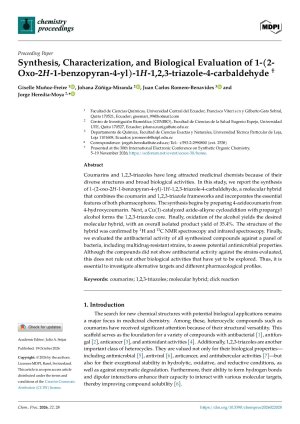
Coumarins and 1,2,3-triazoles have long been of great interest in medicinal chemistry due to their rich structural diversity and their broad spectrum of biological activities. In this study, we report the synthesis of a molecular hybrid that combines the coumarin and 1,2,3-triazole scaffolds, yielding a compound that incorporates characteristics of both pharmacophores. The hybrid 1-(2-oxo-2H-1-benzopyran-4-yl)-1H-1,2,3-triazole-4-carbaldehyde was synthesized from 4-hydroxycoumarin, a readily accessible starting material. The synthetic sequence begins with azidation to introduce the essential azide functionality, followed by a CuAAC click reaction with propargyl alcohol to furnish the 1,2,3-triazole core. Finally, oxidation leads to the formation of the aldehyde group. Finally, oxidation of the alcohol yields the expected molecular hybrid. The overall isolated yield for the target compound was 59.1%, and its structure was confirmed by 1H and 13C-NMR and infrared spectroscopy. The antibacterial activity of all synthesized compounds was evaluated against a panel of bacteria, including multidrug-resistant strains, to assess potential antimicrobial activity. However, the results showed that they did not exhibit antibacterial effects against any of the tested strains. Nonetheless, the absence of antibacterial activity does not diminish the value of the molecular scaffold; rather, it underscores the possibility of other biological activities and prompts further exploration of alternative targets and pharmacological profiles.
Keywords
Coumarins
1,2,3-triazoles
molecular hybrid
click reaction
Manuscript
Sciforum-202866 chemproc-22-00028.pdf
Silver-Catalyzed Regioselective Synthesis of Benzo[b][1,7]naphthyridin-1(2H)-ones through a Water-Assisted Cascade Cyclization
In silico evaluation and prioritization of secondary metabolites of Amphipterygium adstringens as potential inhibitors of the LpxC enzyme of multidrug-resistant Acinetobacter baumannii using computer-aided rational drug design strategies.