Event submissions
Published
 10.3390/chemproc2026022030 (registering DOI)
This submission belongs to the session Session 2. Chemistry of Bioorganics, Medicinal and Natural Products of the event The 30th International Electronic Conference on Synthetic Organic Chemistry
Published date
02 Nov, 2026
Academic Editor
 Julio A. Seijas
Citation
Amina Dridi, Nabila Bouhaddouda, Youssouf Driouche, Meriem Ferfar, Amel Soussa, Study of Phenolic Compounds and Antibacterial Activity of Origanum vulgare ssp. glandulosum, in Proceedings of The 30th International Electronic Conference on Synthetic Organic Chemistry, 5 November–19 November 2026, MDPI: Basel, Switzerland, doi: 10.3390/chemproc2026022030
Share
Email
Facebook
Twitter
LinkedIn
Study of Phenolic Compounds and Antibacterial Activity of Origanum vulgare ssp. glandulosum

Amina Dridi 1
Nabila Bouhaddouda 2
Youssouf Driouche 1

Meriem Ferfar 1
Amel Soussa 1
1. Environmental Research Center (CRE), Annaba, 23000, Algeria
2. Biology Department, Faculty of Sciences, University 20 August 1955, Skikda 21000, Algeria
Abstract
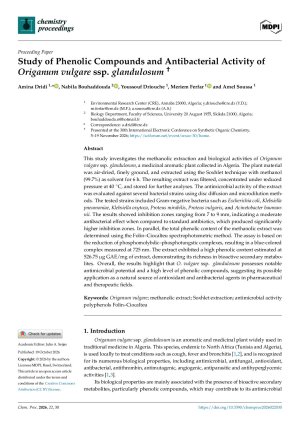
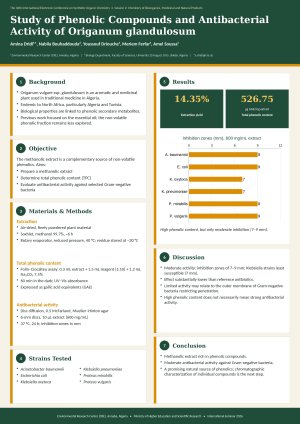
This study investigates the methanolic extraction and biological activities of Origanum vulgare ssp. glandulosum, a medicinal aromatic plant collected in Algeria. The plant material was air-dried, finely ground, and extracted using the Soxhlet technique with methanol (99.7%) as solvent for 6 hours. The resulting extract was filtered, concentrated under reduced pressure at 40 °C, and stored for further analyses.
The antimicrobial activity of the extract was evaluated against several bacterial strains using disk diffusion and microdilution methods. The tested strains included Gram-negative bacteria such as Escherichia coli, Klebsiella pneumoniae, Klebsiella oxytoca, Proteus mirabilis, Proteus vulgaris, and Acinetobacter baumannii. The results showed inhibition zones ranging from 7 to 9 mm, indicating a moderate antibacterial effect when compared to standard antibiotics, which produced significantly higher inhibition zones.
In parallel, the total phenolic content of the methanolic extract was determined using the Folin–Ciocalteu spectrophotometric method. The assay is based on the reduction of phosphomolybdic–phosphotungstic complexes, resulting in a blue-colored complex measured at 725 nm. The extract exhibited a high phenolic content estimated at 526.75 µg GAE/mg of extract, demonstrating its richness in bioactive secondary metabolites.
Overall, the results highlight that O. vulgare ssp. glandulosum possesses notable antimicrobial potential and a high level of phenolic compounds, suggesting its possible application as a natural source of antioxidant and antibacterial agents in pharmaceutical and therapeutic fields.
Keywords
Origanum vulgare
methanolic extract
Soxhlet extraction
antimicrobial activity
polyphenols
Folin–Ciocalteu
Manuscript
Sciforum-194542 chemproc-22-00030.pdf
Poster
Poster_Origanum_glandulosum.pdf
Poster_Origanum_glandulosum_video.mp4
Photochemical reactions of the hydrogen atom transfer between arsines and triplet nitro compounds
Green Chemistry Approach for the Synthesis of Water-Soluble Alkyd Resins