Event submissions
Published
 10.3390/chemproc2026022034 (registering DOI)
This submission belongs to the session Session 1. General Organic Synthesis of the event The 30th International Electronic Conference on Synthetic Organic Chemistry
Published date
02 Nov, 2026
Academic Editor
 Julio A. Seijas
Citation
Jonak Mahanta, Ghanashyam Bez, Double Regioselective Thermal Azide-alkyne Cycloaddition of 1,3-Diynes, in Proceedings of The 30th International Electronic Conference on Synthetic Organic Chemistry, 5 November–19 November 2026, MDPI: Basel, Switzerland, doi: 10.3390/chemproc2026022034
Share
Email
Facebook
Twitter
LinkedIn
Double Regioselective Thermal Azide-alkyne Cycloaddition of 1,3-Diynes

Jonak Mahanta 1
Ghanashyam Bez 1
1. Department of Chemistry, North-Eastern Hill University, Shillong-793022, India
Abstract
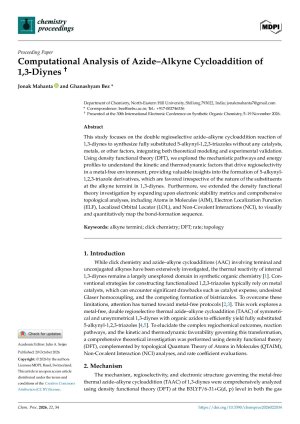
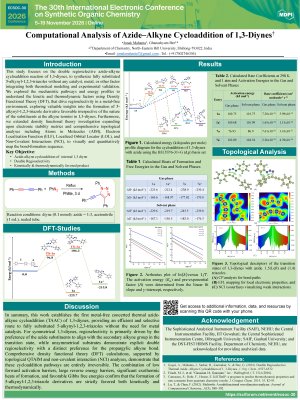
Azide-alkyne cycloaddition (AAC) of alkyne with azides often suffers from a lack of regioselectivity, while its Cu(I) and Ru(II) catalyzed regioselective versions have found immense applications in synthetic and medicinal chemistry. Our study focuses on the double regioselective azide-alkyne cycloaddition reaction of 1,3-diynes, to synthesize fully substituted 5-alkynyl-1,2,3-triazoles without any catalyst, metal, or other factor integrating both theoretical modeling and experimental validation. We explored the mechanistic pathways and energy profiles to understand the kinetic and thermodynamic factors using Density Functional Theory (DFT), that drive regioselectivity in a metal-free environment, exploring valuable insights into the formation of 5-alkynyl-1,2,3-triazole derivative favorable irrespective of the nature of the substituents at the alkyne termini in 1,3-diynes. Furthermore we extended density functional theory investigation expanding upon electronic stability metrics and comprehensive topological analyses including Atoms in Molecules (AIM), Electron Localization Function (ELF), Localized Orbital Locator (LOL), and Non-Covalent Interactions (NCI), to visually and quantitatively map the bond-formation sequence.
The simplicity of the reaction, extremely high regioselectivity under metal-free conditions, wide substrate scope, and both thermodynamically and kinetically favorable products in good to excellent yields. This integrated approach highlights the potential for developing metal-free click reactions with a deeper understanding of regioselective cycloaddition reactions and highlights the potential for developing click chemistry with a broad range of applications.
Reference:
1.Gogoi, A., Mahanta, J., Sarkar, B., Karmakar, S., & Bez, G. (2024). Double Regioselective Thermal Azide–Alkyne Cycloaddition of 1, 3-Diynes. The Journal of Organic Chemistry, 89(9), 6527-6532.
Keywords
Alkyne termini
Click Chemistry
Density Functional Theory (DFT)
1,3-Diynes
Regioselectivity
Topological (AIM
ELF).
Manuscript
Sciforum-203545 chemproc-22-00034.pdf
Poster
[Sciforum-203545] - [Poster] - [Submission accepted].pdf
Synthesis and structural analysis of open-chain zwitterionic Stenhouse salts derived from furfural, morpholine, and tetracarbonitrile derivatives
One-pot synthesis of imidazo[1,2-a]pyridine analogs using pyrrole via GBB reaction