Event submissions
Published
 10.3390/chemproc2026022065 (registering DOI)
This submission belongs to the session Session 2. Chemistry of Bioorganics, Medicinal and Natural Products of the event The 30th International Electronic Conference on Synthetic Organic Chemistry
Published date
02 Nov, 2026
Academic Editor
 Julio A. Seijas
Citation
Sharanya Roy, Anima Pandey, Comparative In Silico Evaluation of Simarouba glauca DC Phytoconstituents with Quinine as Standard Against Malaria Targets: Molecular Docking and ADMET Analysis, in Proceedings of The 30th International Electronic Conference on Synthetic Organic Chemistry, 5 November–19 November 2026, MDPI: Basel, Switzerland, doi: 10.3390/chemproc2026022065
Share
Email
Facebook
Twitter
LinkedIn
Comparative In Silico Evaluation of Simarouba glauca DC Phytoconstituents with Quinine as Standard Against Malaria Targets: Molecular Docking and ADMET Analysis

Sharanya Roy 1
Anima Pandey 1
1. Department of Pharmaceutical Sciences & Technology, Birla Institute of Technology, Mesra, Ranchi, Jharkhand-835215, India
Abstract
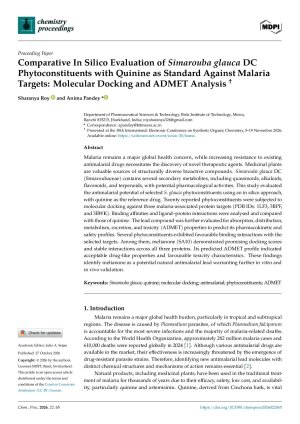
Malaria remains a major global health concern, and the emergence of resistance against currently available antimalarial drugs necessitates the discovery of novel therapeutic molecules. Medicinal plants serve as an important source of structurally diverse bioactive compounds with potential pharmacological applications. Simarouba glauca DC, is known to contain several secondary metabolites, which have been associated with various biological activities. The present study aimed to investigate the antimalarial potential of selected phytoconstituents of S. glauca through an in silico computational approach using quinine as a standard antimalarial reference compound.Twenty reported phytoconstituents of S. glauca were selected and subjected to molecular docking studies against malaria-associated protein targets (PDB IDs: 1LF3, 3BPF, and 3BWK). The docking analysis was performed to evaluate binding affinities, interaction patterns, and the stability of ligand–protein complexes. The docking performance of plant-derived compounds was comparatively assessed with the standard drug quinine to identify promising antimalarial candidates. Further, the lead molecule was evaluated for ADMET properties to predict pharmacokinetic behaviour and safety parameters.The results demonstrated that several phytoconstituents exhibited favourable binding interactions with the selected malaria targets. Among the screened compounds, Melianone showed promising docking scores and stable interactions with the target proteins, indicating its potential inhibitory activity. ADMET prediction revealed acceptable drug-like characteristics with a favourable predicted toxicity profile.The computational findings suggest that S. glauca phytoconstituents possess significant potential as natural antimalarial leads. Melianone may represent a promising candidate for further in vitro and in vivo validation, contributing towards the development of novel plant-based antimalarial therapeutics.
Keywords
Keywords: Simarouba glauca
quinine
molecular docking
antimalarial
phytoconstituents
ADMET.
Manuscript
Sciforum-200741.pdf
One-pot synthesis of imidazo[1,2-a]pyridine analogs using pyrrole via GBB reaction
Microwave-assisted Synthesis and Virtual Evaluation of 2,8-bis(trifluoromethyl)quinolin-4-yl)(piperidin-2-yl)methyl 2-fluorobenzoate: an O-linked mefloquine ester and its ether equivalent