Event submissions
Published
 10.3390/chemproc2026022066 (registering DOI)
This submission belongs to the session Session 2. Chemistry of Bioorganics, Medicinal and Natural Products of the event The 30th International Electronic Conference on Synthetic Organic Chemistry
Published date
02 Nov, 2026
Academic Editor
 Julio A. Seijas
Citation
Joseph C. Oguegbulu, Ukpe Ajima, Johnson Ogoda Onah, Microwave-assisted Synthesis and Virtual Evaluation of 2,8-bis(trifluoromethyl)quinolin-4-yl)(piperidin-2-yl)methyl 2-fluorobenzoate: an O-linked mefloquine ester and its ether equivalent, in Proceedings of The 30th International Electronic Conference on Synthetic Organic Chemistry, 5 November–19 November 2026, MDPI: Basel, Switzerland, doi: 10.3390/chemproc2026022066
Share
Email
Facebook
Twitter
LinkedIn
Microwave-assisted Synthesis and Virtual Evaluation of 2,8-bis(trifluoromethyl)quinolin-4-yl)(piperidin-2-yl)methyl 2-fluorobenzoate: an O-linked mefloquine ester and its ether equivalent

Joseph C. Oguegbulu 1,2,3,4
Ukpe Ajima 1
Johnson Ogoda Onah 1,3
1. Department of Pharmaceutical and Medicinal Chemistry, University of Jos, PMB 2084, Jos, Plateau State, Nigeria
2. Department of Drug Discovery and Biomedical Sciences, Medical University of South Carolina (MUSC), SC 29425, Charleston, USA
3. Department of Pharmaceutical and Medicinal Chemistry, Bingham University, PMB 005, Karu, Nasarawa, Nigeria
4. Department of Chemical Sciences, Bingham University, PMB 005 Karu, Nasarawa, Nigeria.
Abstract
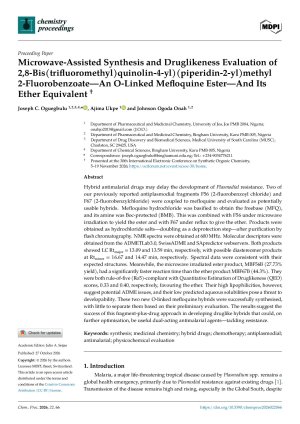
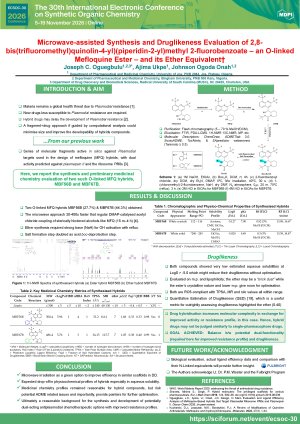
Hybrid antimalarial drugs may delay the development of Plasmodial resistance. Two of our previously reported antiplasmodial fragments F56 (2-fluorobenzoyl chloride) and F67 (2-fluorobenzylchloride) were here coupled to mefloquine and evaluated as potentially usable hybrids. Mefloquine hydrochloride was basified to obtain the (±)-erythro freebase (MFQ), and the amine was boc-protected (BMB). This was combined with F56 under microwave irradiation to yield the ester. F67 was also coupled to BMB under reflux to give the ether. Products were obtained as hydrochloride salts – doubling as a deprotection step – after purification by flash chromatography. Mass spectroscopy (MS), liquid chromatography (LC), and UV-Vis spectroscopy were done on a PDA-LC/MS system. NMR spectra were obtained at 600 MHz. Molecular descriptors were computed on the ADMETLab3.0 and SwissADME webservers. Spectral data were consistent with the expected structures of both O-linked hybrids. The microwave irradiated ester product, MBF56B had a surprisingly lower yield (27.73%) than the ether MBF67B (44.3%). Both products showed LC Rtmajor = 13.09 and 13.59 mins respectively, with respective possible diastereomer products at Rtminor = 16.67 and 14.47 mins. Both compounds were Rule-of-five (Ro5)-compliant with Quantitative Estimation of Druglikeness (QED) scores, 0.33 and 0.40 respectively. Both showed drop-offs in predicted CYP3A4 inhibition. The ester showed improvements in clearance while the ether suggested improved metabolic stability. We successfully synthesised these two mefloquine hybrids, with the ether slightly better overall. Their medicinal chemistry indices intimate the success of this fragment-plus-drug approach in developing relatively drug-like hybrids that could, on bio-evaluation, be useful dual-acting antimalarial agents - tackling resistance.
Keywords
Medicinal chemistry
LCMS
NMR
Pharmacokinetics
ADMET
Antimalarial
Chemotherapy
Hybrid drugs
Manuscript
Sciforum-200379.pdf
Poster
[Sciforum-200379] - [Poster] - [Submission accepted].pdf
Comparative In Silico Evaluation of Simarouba glauca DC Phytoconstituents with Quinine as Standard Against Malaria Targets: Molecular Docking and ADMET Analysis
Synthesis of 5-Bromo-6-methylene-1,3-oxazinan-2-ones via Bromoheterocyclization of Allenyl Carbamates under Metal-Free Conditions