Event submissions
Published
 10.3390/chemproc2026022068 (registering DOI)
This submission belongs to the session Session 2. Chemistry of Bioorganics, Medicinal and Natural Products of the event The 30th International Electronic Conference on Synthetic Organic Chemistry
Published date
02 Nov, 2026
Academic Editor
 Julio A. Seijas
Citation
Gheffar Kher-aldeen Kara, Maya Zanouba, Abd-alrhman dawod, sabahat Mhjazy, Nahla ahmad Bakoura, Mohammad Al-Shahna, Amani Nasser, Removal of a fungal pollutant "Aflatoxine B1" and dye "Allura Red Ac": Kinetic study of the removal reaction on the surface of isolated nanocellulose from various plant sources, in Proceedings of The 30th International Electronic Conference on Synthetic Organic Chemistry, 5 November–19 November 2026, MDPI: Basel, Switzerland, doi: 10.3390/chemproc2026022068
Share
Email
Facebook
Twitter
LinkedIn
Removal of a fungal pollutant "Aflatoxine B1" and dye "Allura Red Ac": Kinetic study of the removal reaction on the surface of isolated nanocellulose from various plant sources

Gheffar Kher-aldeen Kara 1
Maya Zanouba 1
Abd-alrhman dawod 1
sabahat Mhjazy 1
Nahla ahmad Bakoura 1
Mohammad Al-Shahna 1
Amani Nasser 1,2
1. Green and Nano Materials Synthesis Laboratory, Department of Chemistry, Faculty of Science, Latakia University, Latakia, Syria
2. Materials Science and Engineering Laboratory, Department of Design and Production Engineering, Faculty of Mechanical and Electrical Engineering, Latakia University, Latakia, Syria
Abstract
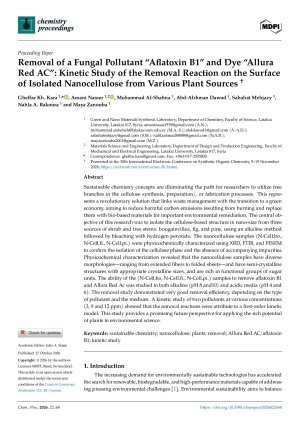
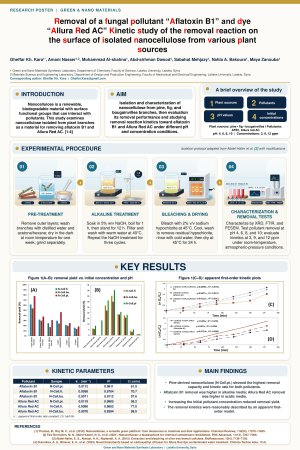
Sustainable chemistry concepts are illuminating the path for researchers to utilize tree branches in cellulose industries. This represents a revolutionary solution that links waste management with the transition to a green economy, aiming to reduce harmful carbon emissions resulting from burning and replace them with bio-based materials for important environmental remediation. The central objective of this research was to isolate the cellulose-based structure in nano-size from three sources of shrub and tree stems: bougainvillea, fig, and pine, using an alkaline method followed by bleaching with hydrogen peroxide. The nanocellulose samples (N-Cell.bo, N-Cell.fi., N-Cell.pi.) were physicochemically characterized using XRD, FTIR, and FESEM to confirm the isolation of the cellulose phase and the absence of accompanying impurities. Physicochemical characterization revealed that: the nanocellulose samples have diverse morphlogies—ranging from extended fibers to folded sheets, have semi-crystalline structures with appropriate crystalline particle sizes, and are rich in functional groups of sugar units. The ability of the (N-Cell.bo, N-Cell.fi., N-Cell.pi.) samples to remove aflatoxin B1 and Allura Red Ac was studied in both alkaline (pH 8 and10) and acidic media (pH 4 and 6). The removal study demonstrated very good removal efficiency, depending on the type of pollutant and the medium. Kinetic study for two pollutants in various concentrations (3, 9 and 12 ppm) showed that the reactions followed the first kinetic model. This study provides a promising future perspective for applying the rich potential of plants in environmental science.
Keywords
Sustainable chemistry
Nano-cellulose
Plants
Removal
Allura Red Ac
Aflatoxin B1
Kinetic study
Manuscript
Sciforum-202262.pdf
Poster
Poster 2.pdf
poster-oo.mp4
Silver-Catalyzed Cascade Annulation of ortho-Alkynyl Aldehydes with Sulfonamides: A Regioselective Access to Sulfonyl-Embedded Polycyclic Fused 1,7-Naphthyridines
Computational Evaluation of a Novel GABAB Receptor Agonist through Molecular Docking, Molecular Dynamics and Binding Free Energy Calculations