Event submissions
Published
 10.3390/chemproc2026022075 (registering DOI)
This submission belongs to the session Session 1. General Organic Synthesis of the event The 30th International Electronic Conference on Synthetic Organic Chemistry
Published date
02 Nov, 2026
Academic Editor
 Julio A. Seijas
Citation
Kapil Chahal, Vijaya Rani Potluri, K. Rajender Reddy, A Tandem Cyclization–Allylation Approach to Allylated Pyranoquinoline Derivatives, in Proceedings of The 30th International Electronic Conference on Synthetic Organic Chemistry, 5 November–19 November 2026, MDPI: Basel, Switzerland, doi: 10.3390/chemproc2026022075
Share
Email
Facebook
Twitter
LinkedIn
A Tandem Cyclization–Allylation Approach to Allylated Pyranoquinoline Derivatives

Kapil Chahal 1
Vijaya Rani Potluri 1
K. Rajender Reddy 1
1. Catalysis and Fine Chemicals Division, CSIR-Indian Institute of Chemical Technology, Hyderabad-500007, Telangana, India
Abstract
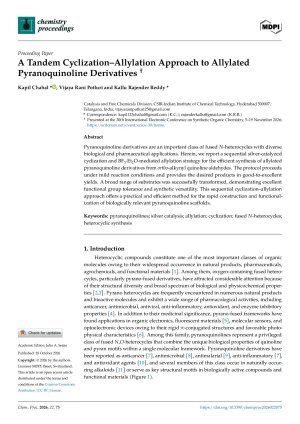
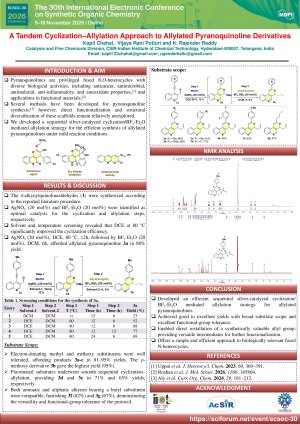
Introduction: Pyranoquinoline derivatives constitute an important class of fused N-heterocycles that exhibit diverse biological activities, including anticancer, antimicrobial, and anti-inflammatory properties. Owing to their significant pharmacological potential, the development of efficient synthetic methodologies for the construction and functionalization of pyranoquinoline frameworks remains an active area of research. In particular, allylated heterocycles are valuable synthetic intermediates, as the allyl group serves as a versatile handle for further structural diversification. Herein, we report a sequential AgNO3-catalyzed cyclization and BF3·Et2O-mediated allylation strategy for the efficient synthesis of allylated pyranoquinoline derivatives.
Methods: The synthetic strategy involved AgNO3-catalyzed cyclization of ortho-alkynyl quinoline aldehydes in the presence of alcohols to generate pyranoquinoline intermediates. Subsequent treatment with allyltributyltin under BF3·Et2O promotion afforded the corresponding allylated products. The scope of the methodology was evaluated using various substrates, and all synthesized compounds were characterized by NMR spectroscopy and HRMS.
Results: The sequential cyclization–allylation protocol efficiently furnished allylated pyranoquinoline derivatives in good to excellent yields. The methodology exhibited broad substrate scope and tolerated a variety of substituents, providing rapid access to structurally diverse allylated fused heterocyclic scaffolds under mild conditions.
Conclusion: A sequential cyclization–allylation strategy has been developed for the efficient synthesis of allylated pyranoquinoline derivatives. The protocol features mild reaction conditions, broad substrate scope, and good to excellent yields, offering a practical approach for the rapid construction and functionalization of biologically relevant fused heterocyclic scaffolds.
Keywords
Pyranoquinolines
Silver catalysis
Allylation
Cyclization
Fused N-heterocycles
Heterocyclic synthesis.
Manuscript
Sciforum-199872 chemproc-22-00075.pdf
Poster
[Sciforum-199872] - [Poster] - [Submission accepted].pdf
Computational Evaluation of a Novel GABAB Receptor Agonist through Molecular Docking, Molecular Dynamics and Binding Free Energy Calculations
Synthesis, Design and Biological Evaluation of Novel Photomodulable Azoderivatives as Cholinesterase Inhibitors