Event submissions
Published
 10.3390/chemproc2026022087 (registering DOI)
This submission belongs to the session Session 2. Chemistry of Bioorganics, Medicinal and Natural Products of the event The 30th International Electronic Conference on Synthetic Organic Chemistry
Published date
02 Nov, 2026
Academic Editor
 Julio A. Seijas
Citation
Vimbanashe Binde, Humphrey Masimba Makumbirofa, Anti‑Inflammatory and Antioxidant Natural Products from Kalanchoe pinnata and Salvia rosmarinus: A Preformulation Study, in Proceedings of The 30th International Electronic Conference on Synthetic Organic Chemistry, 5 November–19 November 2026, MDPI: Basel, Switzerland, doi: 10.3390/chemproc2026022087
Share
Email
Facebook
Twitter
LinkedIn
Anti‑Inflammatory and Antioxidant Natural Products from Kalanchoe pinnata and Salvia rosmarinus: A Preformulation Study

Vimbanashe Binde 1

Humphrey Masimba Makumbirofa 2
1. Walnut Pharmacy, 9 George Silundika Avenue, Harare, Zimbabwe
2. Department of Pharmaceutical Technology, School of Allied Health Sciences, Harare Institute of Technology, 15015 Ganges Road, Belvedere, Harare, Zimbabwe
Abstract
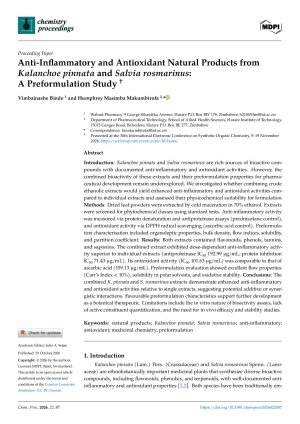
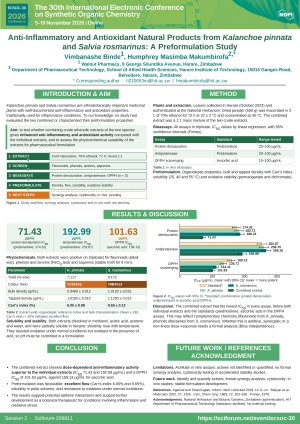
Introduction: Kalanchoe pinnata and Salvia rosmarinus are rich sources of bioactive compounds with documented anti‑inflammatory and antioxidant activities. However, the combined bioactivity of these extracts and their preformulation properties for pharmaceutical development remain underexplored. We investigated whether combining crude ethanolic extracts would yield enhanced anti‑inflammatory and antioxidant activities compared to individual extracts, and assessed their physicochemical suitability for formulation.
Methods: Dried leaf powders were extracted by cold maceration in 70% ethanol. Extracts were screened for phytochemical classes using standard tests. Anti‑inflammatory activity was measured via protein denaturation and antiproteinase assays (prednisolone control), and antioxidant activity via DPPH radical scavenging (ascorbic acid control). Preformulation characterisation included organoleptic properties, bulk density, flow indices, solubility, and partition coefficient.
Results: Both extracts contained flavonoids, phenols, tannins, and saponins. The combined extract exhibited dose‑dependent anti‑inflammatory activity superior to individual extracts (antiproteinase IC₅₀ 192.99 µg/mL; protein inhibition IC₅₀ 71.43 µg/mL). Its antioxidant activity (IC₅₀ 101.63 µg/mL) was comparable to that of ascorbic acid (159.13 µg/mL). Preformulation evaluation showed excellent flow properties (Carr’s Index <10%), solubility in polar solvents, and oxidative stability.
Conclusions: The combined K. pinnata and S. rosmarinus extracts demonstrate enhanced anti‑inflammatory and antioxidant activities relative to single extracts, suggesting potential additive or synergistic interactions. Favourable preformulation characteristics support further development as a botanical therapeutic. Limitations include the in vitro nature of bioactivity assays, lack of active constituent quantification, and the need for in vivo efficacy and stability studies.
Keywords
Natural products
Kalanchoe pinnata
Salvia rosmarinus
anti‑inflammatory
antioxidant
medicinal chemistry
preformulation
Manuscript
Sciforum-206811.pdf
Poster
[Sciforum-206811] - [Poster] - [Submission accepted].pdf
Synthesis, Design and Biological Evaluation of Novel Photomodulable Azoderivatives as Cholinesterase Inhibitors
Tris(dimethylamino)-phosphan-phenylimine as photoluminescent organophosphorus additive for polylactic acid films