Event submissions
Published
 10.3390/chemproc2026022076 (registering DOI)
This submission belongs to the session Session 1. General Organic Synthesis of the event The 30th International Electronic Conference on Synthetic Organic Chemistry
Published date
02 Nov, 2026
Academic Editor
 Julio A. Seijas
Citation
Valentina Beghetto, Marco Bortoluzzi, Valeria Gagliardi, Domenico Piccolo, Tris(dimethylamino)-phosphan-phenylimine as photoluminescent organophosphorus additive for polylactic acid films, in Proceedings of The 30th International Electronic Conference on Synthetic Organic Chemistry, 5 November–19 November 2026, MDPI: Basel, Switzerland, doi: 10.3390/chemproc2026022076
Share
Email
Facebook
Twitter
LinkedIn
Tris(dimethylamino)-phosphan-phenylimine as photoluminescent organophosphorus additive for polylactic acid films

Valentina Beghetto 1,2

Marco Bortoluzzi 1,2
Valeria Gagliardi 1
Domenico Piccolo 1
1. Dipartimento di Scienze Molecolari e Nanosistemi, Università Ca’Foscari Venezia,30172 Mestre, Italy
2. CIRCC (Consorzio Interuniversitario Reattività Chimica e Catalisi), Via Celso Ulpiani 27, 70126 Bari, Italy
Abstract
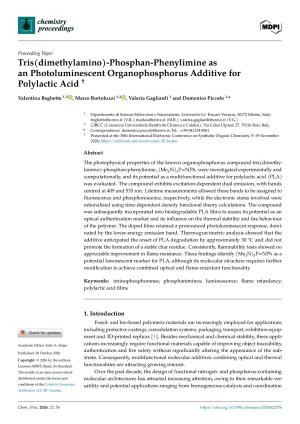
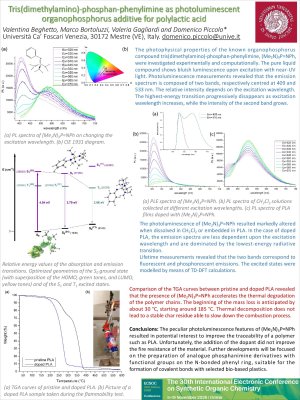
The organophosphorus compound tris(dimethylamino)-phosphan-phenylimine, (Me2N)3P=NPh, was synthesized through the Staudinger reaction between tris(dimethylamino)-phosphine (Me2N)3P and phenylazide PhN3, according to a reported procedure [1]. The structure of the compound was confirmed by means of multinuclear NMR spectroscopy. The pure compound exhibits appreciable photoluminescence in the violet-blue region under irradiation with a Wood lamp. Spectrofluorimetric measurements revealed that (Me2N)3P=NPh is characterized by excitation-dependent dual emission. The two bands are centered at 409 and 533 nm, respectively. Photoluminescence excitation spectra allowed to conclude that the two bands are correlated and, according to time-correlated experiments, attributable to fluorescent and phosphorescent radiative decays. The excited states involved were rationalized by means of time-dependent density functional theory (TD-DFT) calculations. The presence of two distinct emission bands makes the emission of (Me2N)3P=NPh excitation dependent [2].
The unexpected luminescence features of (Me2N)3P=NPh and its appreciable stability prompted to consider this species as dopant for biodegradable plastics, polylactic acid (PLA) in particular. Thin PLA films containing variable amounts of (Me2N)3P=NPh were prepared through optimized procedures and characterized spectroscopically. The luminescence associated with the presence of the embedded dopant molecules was investigated in detail. Given the composition of (Me2N)3P=NPh, thermal measurements and flammability tests were also performed to verify whether the compound could behave as multifunctional dopant for PLA films [3].
Tang, J. et al. J. Am. Chem. Soc. 1993, 115, 5015-5020. Alfani, G.A. et al. Chem. Commun. 2025, 61, 17770–17786. Nazir, R. et al. J. Appl. Polym. Sci. 2020, 137, 47910.
Keywords
photoluminescent materials
flame retardant agents
polimeric films
Manuscript
Sciforum-200798 chemproc-22-00076.pdf
Poster
[Sciforum-200798] - [Poster] - [Submission accepted].pdf
Anti‑Inflammatory and Antioxidant Natural Products from Kalanchoe pinnata and Salvia rosmarinus: A Preformulation Study
EVALUATION OF PLANT METABOLITES EXTRACTED FROM MANGO AND ROSEMARY FOR THE GREEN SYNTHESIS OF SILVER NANOPARTICLES