Event submissions
Published
 10.3390/chemproc2026022080 (registering DOI)
This submission belongs to the session Session 2. Chemistry of Bioorganics, Medicinal and Natural Products of the event The 30th International Electronic Conference on Synthetic Organic Chemistry
Published date
02 Nov, 2026
Academic Editor
 Julio A. Seijas
Contribution&Funding
Conceptualization,
[María Alejandra Rodríguez] ; [Valeria Gallo] ; [Valentina Vanegas]
Methodology,
[María Alejandra Rodríguez] ; [Valeria Gallo] ; [Valentina Vanegas] ; [Génesis González]
Software,
[Génesis González]
Formal analysis,
[Valentina Vanegas]
Investigation,
[Valeria Gallo] ; [Valentina Vanegas]
Writing - original draft,
[Valeria Gallo] ; [Valentina Vanegas]
Writing - review,
[editing] ; [María Alejandra Rodríguez]
Supervision,
[Génesis González]
Funding: --
Citation
María Alejandra Rodríguez, Valeria Gallo, Valentina Vanegas, Génesis González, EVALUATION OF PLANT METABOLITES EXTRACTED FROM MANGO AND ROSEMARY FOR THE GREEN SYNTHESIS OF SILVER NANOPARTICLES, in Proceedings of The 30th International Electronic Conference on Synthetic Organic Chemistry, 5 November–19 November 2026, MDPI: Basel, Switzerland, doi: 10.3390/chemproc2026022080
Share
Email
Facebook
Twitter
LinkedIn
EVALUATION OF PLANT METABOLITES EXTRACTED FROM MANGO AND ROSEMARY FOR THE GREEN SYNTHESIS OF SILVER NANOPARTICLES

María Alejandra Rodríguez 1
Valeria Gallo 1
Valentina Vanegas 1
Génesis González 2
1. Faculty of Engineering, Department of Energy and Automation, Universidad Metropolitana, Caracas 1073, Venezuela
2. Faculty of Science, Universidad Central de Venezuela, Caracas 1050, Venezuela
Abstract
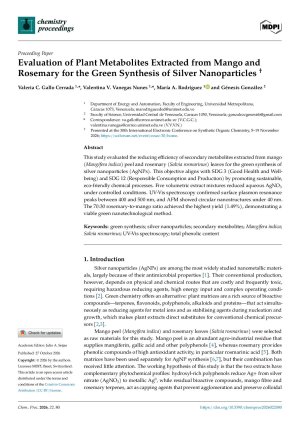
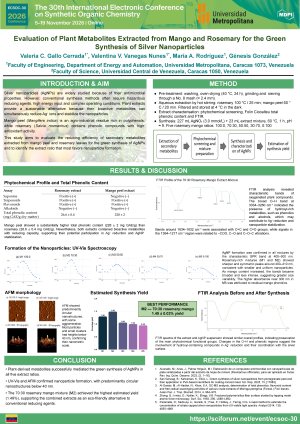
Green synthesis of metallic nanoparticles emerges as a sustainable alternative to conventional chemical methods, which often require hazardous reagents, high energy consumption, and complex operating conditions. This research aimed to evaluate the reducing capacity of secondary metabolites extracted from mango (Mangifera indica) peels and rosemary (Salvia rosmarinus) leaves in the green synthesis of silver nanoparticles, aligning with Sustainable Development Goals (SDGs) 3 (Good Health and Well-being) and 12 (Responsible Consumption and Production). To achieve this, aqueous extracts were obtained through hot agitation, and five mixtures in different proportions were prepared to reduce a silver nitrate solution. The extracts were characterized via phytochemical screening, total phenolic content determination using the Folin-Ciocalteu method, and Fourier-transform infrared (FTIR) spectroscopy. The formation of silver nanoparticles was evaluated through color change, UV-Vis spectroscopy, and atomic force microscopy (AFM). The results revealed a phenolic content of 26.6 mg GAE/g for rosemary and 228 mg GAE/g for mango. FTIR spectra displayed functional groups (-OH, C=O, C-O, and C-O-C) linked to the reduction and stabilization of silver nanoparticles (AgNPs). UV-Vis spectroscopy confirmed surface plasmon resonance bands between 400 and 500 nm, while AFM suggested predominantly spherical nanostructures with heights under 40 nm. The M2 mixture (70% rosemary - 30% mango) exhibited the highest yield at 1.486%. In conclusion, the evaluated extracts demonstrated significant potential for the green synthesis of AgNPs, highlighting the mango-rosemary combination as a viable and eco-friendly alternative.
Keywords
Green synthesis
silver nanoparticles
secondary metabolites
UV-Vis spectroscopy
Mangifera indica
Salvia rosmarinus.
Manuscript
Sciforum-207431.pdf
Poster
[Sciforum-207431] - [Poster] - [Submission accepted].pdf
Tris(dimethylamino)-phosphan-phenylimine as photoluminescent organophosphorus additive for polylactic acid films
Exploration of Multiple Synthetic Approaches toward Cyanogramide: Challenges, Mechanistic Insights, and Future Perspectives