Event submissions
Published
 10.3390/chemproc2026022078 (registering DOI)
This submission belongs to the session Session 1. General Organic Synthesis of the event The 30th International Electronic Conference on Synthetic Organic Chemistry
Published date
02 Nov, 2026
Academic Editor
 Julio A. Seijas
Citation
Vladislava V. Shramenko, Alexander V. Bespalov, Victor V. Dotsenko, Marina Shevelyova, Evgeniya Deryusheva, Ekaterina Andreevna Litus, Novel molecular hybrids of indolin-2-one and pyrano[3,2-b]pyran: synthesis via α-thiocyanatoacetophenone and chlorokojic acid, and molecular docking study, in Proceedings of The 30th International Electronic Conference on Synthetic Organic Chemistry, 5 November–19 November 2026, MDPI: Basel, Switzerland, doi: 10.3390/chemproc2026022078
Share
Email
Facebook
Twitter
LinkedIn
Novel molecular hybrids of indolin-2-one and pyrano[3,2-b]pyran: synthesis via α-thiocyanatoacetophenone and chlorokojic acid, and molecular docking study

Vladislava V. Shramenko 1
Alexander V. Bespalov 1
Victor V. Dotsenko 1,2
Marina Shevelyova 3
Evgeniya Deryusheva 3
Ekaterina Andreevna Litus 3
1. Department of Organic Chemistry and Technologies, Kuban State University, 149 Stavropolskaya St., 350040 Krasnodar, Russia
2. Department of Chemistry, North-Caucasus Federal University, 1 Pushkina St., 355017 Stavropol, Russia
3. lnstitute for Biological lnstrumentation of the Russian Academy of sciences, Pushchino scientific center for Biological Research of the Russian Academy of Sciences, 7 lnstitutskaya St., 142290 Pushchino, Moscow Region, Russia
Abstract
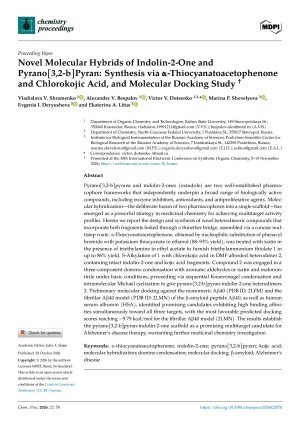
Pyrano[3,2-b]pyran and indolin-2-one (oxindole) are two well-established pharmacophore frameworks that independently underpin a broad range of biologically active compounds, including enzyme inhibitors, antioxidants, and antiproliferative agents. Molecular hybridization — the deliberate fusion of two pharmacophores into a single scaffold — has emerged as a powerful strategy in medicinal chemistry for achieving multitarget activity profiles. Herein we report the design and synthesis of novel heterodimeric compounds that incorporate both fragments linked through a thioether bridge, assembled via a concise multistep route. α-Thiocyanatoacetophenone, obtained by nucleophilic substitution of phenacyl bromide with potassium thiocyanate in ethanol (88–93% yield), was treatedwith isatin in the presence of triethylamine in ethyl acetate to furnish triethylammonium thiolate 1 in up to 86% yield. S-Alkylation of 1 with chlorokojic acid in DMF afforded heterodimer 2, containing intact indolin-2-one and kojic acid fragments. Compound 2 was engaged in a three-component domino condensation with aromatic aldehydes or isatin and malononitrile under basic conditions, proceeding via sequential Knoevenagel condensation and intramolecular Michael cyclization to give pyrano[3,2-b]pyran–indolin-2-one heterodimers 3. Preliminary molecular docking against the monomeric (PDB: 2lfm) and protofibrillar (PDB: 2lmn) forms of the β-amyloid peptide Aβ40, as well as human serum albumin (HSA), identified promising candidates exhibiting high binding affinities simultaneously toward all three targets, with binding energies reaching −10.41 kcal/mol for 2lmn and −9.8 kcal/mol for HSA. The results establish the pyrano[3,2-b]pyran–indolin-2-one scaffold as a promising multitarget candidate for Alzheimer's disease therapy, warranting further medicinal chemistry investigation.
Keywords
α-thiocyanatoacetophenone
indolin-2-one
pyrano[3,2-b]pyran
kojic acid
molecular hybridization
domino condensation
molecular docking
β-amyloid
Alzheimer's disease.
Manuscript
Sciforum-201619 chemproc-22-00078.pdf
In Silico Evaluation of a Novel Monoamine Oxidase-B Inhibitor as a Potential Therapeutic Candidate for Parkinson's Disease
Synthesis and Multifaceted Investigation of a Naphthyl-Thiazole Hydrazone: Spectroscopic Characterization, DFT, Antimicrobial Evaluation, Molecular Docking and Drug-Likeness Assessment