Event submissions
Published
 10.3390/chemproc2026022086 (registering DOI)
This submission belongs to the session Session 1. General Organic Synthesis of the event The 30th International Electronic Conference on Synthetic Organic Chemistry
Published date
02 Nov, 2026
Academic Editor
 Julio A. Seijas
Citation
Didier Villemin, Linda Loucif Seiad, Messaoud Hachemi, Nathalie Bar, C3 symmetric hydrazine scaffold: new coordinating hydrazones for metal cations, in Proceedings of The 30th International Electronic Conference on Synthetic Organic Chemistry, 5 November–19 November 2026, MDPI: Basel, Switzerland, doi: 10.3390/chemproc2026022086
Share
Email
Facebook
Twitter
LinkedIn
C3 symmetric hydrazine scaffold: new coordinating hydrazones for metal cations

Didier Villemin 1
Linda Loucif Seiad 2
Messaoud Hachemi 2
Nathalie Bar 1
1. Institut CARMeN UMR 6064 CNRS (ex LCMT), ENSICAEN, Univ Caen Normandie, Univ Rouen Normandie, INSA Rouen Normandie, F-14050 Caen, France
2. Département de Chimie, Faculté des Sciences de l’Ingénieur, Université M’Hamed Bougara -35000 Boumerdes, Algérie.
Abstract
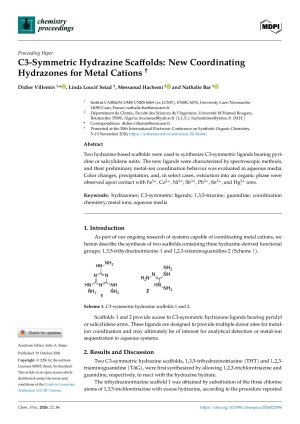
Two C3-symmetric hydrazine scaffolds, 1,2,3-triaminoguanidine (TAG) and 2,4,6-trihydrazino-1,3,5-triazine (THT), were first synthesized by the reactions of guanidine and 1,2,3-trichlorotriazine, respectively, with hydrazine hydrate. Hydrazone derivatives of TAG and THT were subsequently prepared by condensation with 2-, 3-, and 4-pyridinecarboxaldehydes as well as salicylaldehyde. The synthesized compounds were characterized by spectroscopic methods.
Owing to the presence of both pyridine and hydrazone donor groups, these compounds are expected to exhibit good coordination ability towards metal ions.1 Since transition-metal and heavy-metal ions are important environmental contaminants,2 the coordination properties of the synthesized hydrazones were investigated in aqueous media. Ethanolic solutions of hydrazones were added to aqueous solutions containing Fe³⁺, Co²⁺, Ni²⁺, Sb³⁺, Pb²⁺, Sn²⁺, and Hg²⁺ ions. Formation of precipitates and/or colored complexes was observed for several metal ions, indicating efficient coordination.
These results suggest that the synthesized hydrazones could be promising ligands for metal-ion coordination and could be useful as analytical reagents for the detection of metal ions in water by visible spectroscopy or gravimetric methods.
1- A. I. Gomaa, E. A. Gomaa, R. R. Zaky, M. N. Abd El-Hady, Design and Synthesis of Pyridine Bis-Hydrazone Metal Complexes of Co(II), Cu(II), and Hg(II): Spectral, Gaussian, Electrochemical, Biological, Drug-Likeness and Molecular Docking Investigations. Inorg. Chem. Comm. 2024, 162, 112188; https://doi.org/10.1016/j.inoche.2024.112188
2- S. Kaya, C. W. B. Bezerra, R. Fernandes de Farias, A. Çetindağ Çiltaş, M. Elik, Metal cations toxicity: An inorganic interpretation, J. Indian Chem. Soc., 2023, 100, (1) 1, 2023, 100840; doi: 10.1016/j.jics.2022.100840
Keywords
hydrazones
C3-symmetric ligands
triazine
guanidine
coordination chemistry
transition metals
heavy metals
metal-ion sensing
Manuscript
Sciforum-202384 chemproc-22-00086.pdf
Phytocompounds from Justicia adhatoda as Potential Thrombopoietic Agents: Docking and Preclinical Evaluation with c-Mpl Receptor
Synthesis and NMR Characterization of a 4-Aminochalcone–Salicylic Acid Azo Conjugate as a Potential Prodrug