Event submissions
Published
 10.3390/chemproc2026022085 (registering DOI)
This submission belongs to the session Session 1. General Organic Synthesis of the event The 30th International Electronic Conference on Synthetic Organic Chemistry
Published date
02 Nov, 2026
Academic Editor
 Julio A. Seijas
Citation
Moises Humberto Alejandro, Ever Arquímedes Blé, Miguel Angel Vilchis, Quirino Torres, Synthesis and NMR Characterization of a 4-Aminochalcone–Salicylic Acid Azo Conjugate as a Potential Prodrug, in Proceedings of The 30th International Electronic Conference on Synthetic Organic Chemistry, 5 November–19 November 2026, MDPI: Basel, Switzerland, doi: 10.3390/chemproc2026022085
Share
Email
Facebook
Twitter
LinkedIn
Synthesis and NMR Characterization of a 4-Aminochalcone–Salicylic Acid Azo Conjugate as a Potential Prodrug

Moises Humberto Alejandro 1
Ever Arquímedes Blé 1
Miguel Angel Vilchis 1
Quirino Torres 1
1. Division of Basic Sciences, Juárez Autonomous University of Tabasco, Tabasco 86690, Mexico.
Abstract
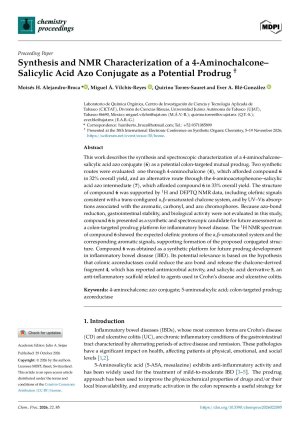
This work describes two synthetic routes to a 4-aminochalcone-derived salicylic acid azo conjugate (1), proposed as a potential colon-targeted prodrug. In the first route, 4-nitroacetophenone was reduced to the corresponding 4-aminoacetophenone, which subsequently underwent a Claisen–Schmidt condensation with benzaldehyde to afford 4-aminochalcone. The latter was diazotized using NaNO₂, and the resulting diazonium intermediate was coupled with salicylic acid at its 5-position to obtain the target compound 1 in an overall yield of 50%.
An alternative synthetic route to compound 1 was also investigated. First, 4-nitroacetophenone was reduced and subsequently diazotized. The resulting diazonium intermediate was then coupled with salicylic acid to afford the 4-aminoacetophenone-derived salicylic acid azo conjugate (2). This intermediate was subjected to a Claisen–Schmidt condensation with benzaldehyde to produce compound 1 in an overall yield of 51%.
The ¹H NMR spectrum of compound 1 showed the expected olefinic resonances of the α,β-unsaturated carbonyl system and the corresponding aromatic signals, supporting the proposed structure. Compound 1 represents a potential synthetic platform for the development of azo prodrugs intended for the treatment of inflammatory bowel disease (IBD). Reduction of its azo bond by colonic azoreductases could potentially release 4-aminochalcone, which has reported antimicrobial activity, and 5-aminosalicylic acid, an anti-inflammatory drug widely used in the management of ulcerative colitis and Crohn’s disease.
Keywords
Chalcone
azoderivatives
prudrugs
IBD
Manuscript
Sciforum-202503 chemproc-22-00085.pdf
C3 symmetric hydrazine scaffold: new coordinating hydrazones for metal cations
Scalable synthesis of the major component, geraniol butyrate, of the pheromone of Agriotes sp., an agricultural pest in Ecuador