Event submissions
Published
 10.3390/chemproc2026022079 (registering DOI)
This submission belongs to the session Session 1. General Organic Synthesis of the event The 30th International Electronic Conference on Synthetic Organic Chemistry
Published date
02 Nov, 2026
Academic Editor
 Julio A. Seijas
Contribution&Funding
Conceptualization,
[Juan Enrique Tacoronte Morales]
Methodology,
[Juan Enrique Tacoronte Morales]
Formal analysis,
[Jhon Walter Muñoz Torres]
Investigation,
[Juan Enrique Tacoronte Morales] ; [Jhon Walter Muñoz Torres]
Data curation,
[Jhon Walter Muñoz Torres]
Writing - original draft,
[Juan Enrique Tacoronte Morales]
Writing - review,
[editing] ; [Jhon Walter Muñoz Torres]
Project administration,
[Jhon Walter Muñoz Torres]
Funding acquisition,
[Jhon Walter Muñoz Torres]
Funding: --
Citation
Juan Enrique Tacoronte Morales, Jhon Walter Muñoz Torres, Scalable synthesis of the major component, geraniol butyrate, of the pheromone of Agriotes sp., an agricultural pest in Ecuador, in Proceedings of The 30th International Electronic Conference on Synthetic Organic Chemistry, 5 November–19 November 2026, MDPI: Basel, Switzerland, doi: 10.3390/chemproc2026022079
Share
Email
Facebook
Twitter
LinkedIn
Scalable synthesis of the major component, geraniol butyrate, of the pheromone of Agriotes sp., an agricultural pest in Ecuador

Juan Enrique Tacoronte Morales 1,2
Jhon Walter Muñoz Torres 1
1. Green Science Laboratory. Green Chemistry & Envirronmental Division. Isaac Newton 1B, Quito, PC 170202, Ecuador
2. Environmental & Education Division, IT Learning Consulting, Svedje, Oviken 84572, Sweden
Abstract
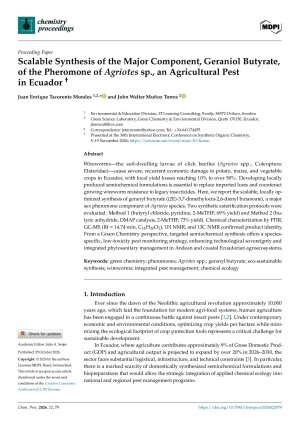
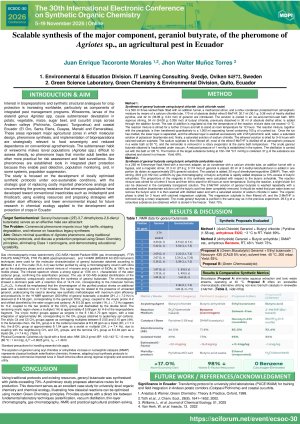
This study reports the synthesis of geranyl butyrate, a sex pheromone analog of Agriotes spp. click beetles (Coleoptera: Elateridae), whose soil-dwelling larvae — wireworms — cause severe economic losses in cotton, maize, and vegetable crops across Ecuador. The present work targets the development of locally optimized, eco-sustainable protocols to replace costly imported analogs and address the growing resistance of wireworm populations to conventional insecticides (imidacloprid, thiodicarb).
Application doses of 5 and 10 mg were optimized for adult population monitoring and direct control. Two esterification routes were evaluated. Method 1 used butyryl chloride in anhydrous diethyl ether with pyridine, affording the target ester in 60% yield. Method 2 employed butyric anhydride with DMAP catalysis in toluene, accelerating the acylation kinetics and achieving a superior yield of >73%, making it the preferred synthetic protocol.
Molecular characterization by FTIR, GC/MS, and ¹H NMR, combined with physicochemical analysis, confirmed the product as a colorless liquid with characteristic floral odor and 98% purity. Column chromatography (SiO₂; n-hexane/ethyl acetate 95:5) was critical for removing persistent azeotropic impurities. Chemical stability studies revealed hydrolytic sensitivity under non-neutral pH, with direct implications for field formulation design.
From a green chemistry view, targeted synthesis of this structure-specific, low-toxicity ester substantially reduces the environmental impact associated with broad-spectrum pesticide use, promoting a technological sovereignty model in integrated phytosanitary protection. Ongoing research currently explores phase transfer catalysis, heterogeneous catalysts, and microwave-assisted synthesis to further improve yields, atom economy, and process scalability; these results will be reported in forthcoming communications.
Keywords
green chemistry
pheromone
Agriotes
eco-sustainable protocols
natural products
Manuscript
Sciforum-207949 chemproc-22-00079.pdf
Poster
[Sciforum-207949] - [Poster] - [Submission accepted].pdf
Synthesis and NMR Characterization of a 4-Aminochalcone–Salicylic Acid Azo Conjugate as a Potential Prodrug
Design and evaluation of novel triazole derivatives as potential anti-gout inhibitors: A comprehensive molecular modeling study