Event submissions
Published
 10.3390/chemproc2026022083 (registering DOI)
This submission belongs to the session Session 1. General Organic Synthesis of the event The 30th International Electronic Conference on Synthetic Organic Chemistry
Published date
02 Nov, 2026
Academic Editor
 Julio A. Seijas
Citation
Varvara Novak, Vyacheslav Kindop, Victor Dotsenko, Recyclization and biological activity of thiocyanatoacetamides containing a thieno[2,3-b]quinoline fragment, in Proceedings of The 30th International Electronic Conference on Synthetic Organic Chemistry, 5 November–19 November 2026, MDPI: Basel, Switzerland, doi: 10.3390/chemproc2026022083
Share
Email
Facebook
Twitter
LinkedIn
Recyclization and biological activity of thiocyanatoacetamides containing a thieno[2,3-b]quinoline fragment

Varvara Novak 1
Vyacheslav Kindop 1
Victor Dotsenko 1
1. Faculty of Chemistry and High Technologies, Kuban State University, Krasnodar, 350040, Russia
Abstract
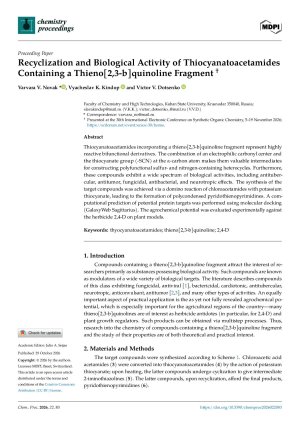
Thiocyanatoacetamides incorporating a thieno[2,3-b]quinoline fragment represent highly reactive bifunctional derivatives. The combination of an electrophilic carbonyl center and the thiocyanate group (-SCN) at the α-carbon atom makes them valuable intermediates for constructing polyfunctional sulfur- and nitrogen-containing heterocycles. Furthermore, these compounds exhibit a wide spectrum of biological activities, including antitubercular, antitumor, fungicidal, antibacterial, and neurotropic effects.
The synthesis of the target compounds was achieved via a domino reaction of chloroacetamides with potassium thiocyanate, leading to the formation of polycondensed pyridothienopyrimidines. In this study, 8 novel representatives were synthesized for the first time. Their structures were fully characterized by IR spectrophotometry and 1H and 13C NMR spectroscopy. A computational prediction of potential protein targets was performed using molecular docking (Galaxy Web Sagittarius). The agrochemical potential was evaluated experimentally against the herbicide 2,4-D on plant models.
Molecular docking studies revealed that the synthesized compounds are capable of binding to the active site of the Keap1 protein, a well-known sensor of oxidative stress, as well as exhibiting complementary interactions with the AMPA receptor GluR2, a central nervous system receptor involved in excitatory signal transmission. Furthermore, an experimental evaluation of the agrochemical potential against the herbicide 2,4-D was performed, demonstrating that the target molecules exhibit significant activity as potential antidotes and plant growth regulators.
Keywords
Thiocyanatoacetamides
thieno[2,3-b]quinoline
2,4-D
Manuscript
Sciforum-201934 chemproc-22-00083.pdf
Unsymmetrical Ethylenediamine Heterocyclic Schiff-Base Ligands for Potential Anticancer Metal Complexes
Multi-Target In Silico Evaluation of Bioactive Phytocompounds from Irvingia gabonensis Seeds Against Oncogenic Proteins: A Computational Drug Discovery Perspective