Event submissions
Published
This submission belongs to the session Session 2. Chemistry of Bioorganics, Medicinal and Natural Products of the event The 30th International Electronic Conference on Synthetic Organic Chemistry
Published date
02 Nov, 2026
Academic Editor
 Julio A. Seijas
Citation
Yusuf Jimoh, Hayder Raed Fadhil, Zukhruf Salami, Abdullahi Ahmad, Multi-Target In Silico Evaluation of Bioactive Phytocompounds from Irvingia gabonensis Seeds Against Oncogenic Proteins: A Computational Drug Discovery Perspective, in Proceedings of The 30th International Electronic Conference on Synthetic Organic Chemistry, 5 November–19 November 2026, MDPI: Basel, Switzerland
Share
Email
Facebook
Twitter
LinkedIn
Multi-Target In Silico Evaluation of Bioactive Phytocompounds from Irvingia gabonensis Seeds Against Oncogenic Proteins: A Computational Drug Discovery Perspective

Yusuf Jimoh 1
Hayder Raed Fadhil 2,3
Zukhruf Salami 1
Abdullahi Ahmad 1
1. Department of Pharmaceutical and Medicinal Chemistry, Ahmadu Bello University, Zaria 810107, Nigeria
2. National Center for Drug Control and Research, Department of Technical affairs, Ministry of Iraqi Health, Baghdad 10047, Iraq
3. Department of Pharmacy, Al-Rasheed University College, Baghdad 10044, Iraq
Abstract
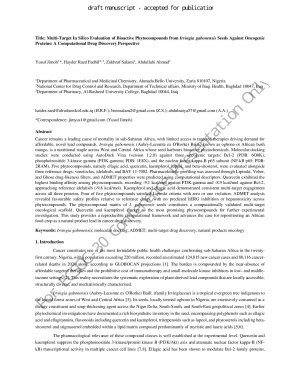
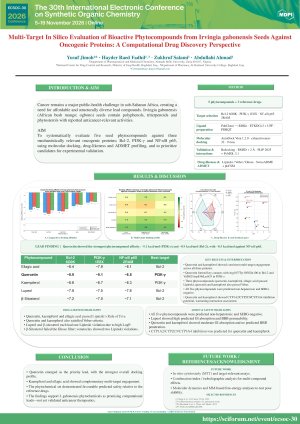
Cancer remains a leading cause of mortality in sub-Saharan Africa, with limited access to targeted therapies driving demand for affordable, novel lead compounds. Irvingia gabonensis (Aubry-Lecomte ex O'Rorke) Baill., known as ogbono or African bush mango, is a nutritional staple across West and Central Africa whose seed harbours bioactive phytochemicals. Molecular docking studies were conducted using AutoDock Vina (version 1.2.0) against three oncogenic targets: Bcl-2 (PDB: 6O0K), phosphoinositide 3-kinase gamma (PI3K-gamma; PDB: 1E8X), and the nuclear factor kappa-B p65 subunit (NF-kB p65; PDB: 2RAM). Five phytocompounds, namely ellagic acid, quercetin, kaempferol, lupeol, and beta-sitosterol, were evaluated alongside three reference drugs: venetoclax, idelalisib, and BAY 11-7082. Pharmacokinetic profiling was assessed through Lipinski, Veber, and Ghose drug-likeness filters, and ADMET properties were predicted using computational descriptors. Quercetin exhibited the highest binding affinity among phytocompounds, recording -9.1 kcal/mol against PI3K-gamma and -8.9 kcal/mol against Bcl-2, approaching reference idelalisib (-9.8 kcal/mol). Kaempferol and ellagic acid demonstrated consistent multi-target engagement across all three proteins. Four of five phytocompounds satisfied Lipinski criteria with zero or one violation. ADMET analysis revealed favourable safety profiles relative to reference drugs, with no predicted hERG inhibition or hepatotoxicity across phytocompounds. The phytocompound matrix of I. gabonensis seeds constitutes a computationally validated multi-target oncological scaffold. Quercetin and kaempferol emerge as priority leads for further in vitro validation. This study provides a reproducible computational framework and advances the case for repositioning an African food crop as a natural product lead in cancer drug discovery
Keywords
Irvingia gabonensis
molecular docking
ADMET
multi-target drug discovery
natural products oncology
Manuscript
[Sciforum-202075] - [Manuscript PDF] - [Submission accepted].pdf
Poster
[Sciforum-202075] - [Poster] - [Submission accepted].pdf
Recyclization and biological activity of thiocyanatoacetamides containing a thieno[2,3-b]quinoline fragment
Synthesis and Evaluation of the Biological Activity of New 3‑Amino‑4‑Aryl‑6‑Oxo‑4,5,6,7‑Tetrahydrothieno[2,3‑b]pyridines via the Thorpe–Ziegler Reaction