Event submissions
Published
 10.3390/chemproc2026022082 (registering DOI)
This submission belongs to the session Session 1. General Organic Synthesis of the event The 30th International Electronic Conference on Synthetic Organic Chemistry
Published date
02 Nov, 2026
Academic Editor
 Julio A. Seijas
Citation
Timofey Tsymbal, Polina Dahno, Arina Levchenko, Victor Dotsenko, Tatyana Hagur, Anatasia Abramova, Eva Daus, Alisa Khomyakova, Synthesis and Evaluation of the Biological Activity of New 3‑Amino‑4‑Aryl‑6‑Oxo‑4,5,6,7‑Tetrahydrothieno[2,3‑b]pyridines via the Thorpe–Ziegler Reaction, in Proceedings of The 30th International Electronic Conference on Synthetic Organic Chemistry, 5 November–19 November 2026, MDPI: Basel, Switzerland, doi: 10.3390/chemproc2026022082
Share
Email
Facebook
Twitter
LinkedIn
Synthesis and Evaluation of the Biological Activity of New 3‑Amino‑4‑Aryl‑6‑Oxo‑4,5,6,7‑Tetrahydrothieno[2,3‑b]pyridines via the Thorpe–Ziegler Reaction

Timofey Tsymbal 1
Polina Dahno 1
Arina Levchenko 1
Victor Dotsenko 1
Tatyana Hagur 1
Anatasia Abramova 1
Eva Daus 1
Alisa Khomyakova 1
1. Department of organic chemistry, Kuban State University, Krasnodar, Russia
Abstract
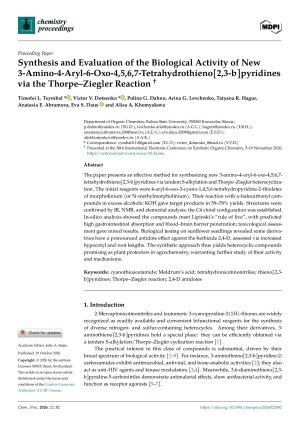
The paper presents an effective method for the synthesis of new 3-amino-4-aryl-6-oxo-4,5,6,7-tetrahydrothieno[2,3-b]pyridines using the tandem reaction of S-alkylation and subsequent Thorpe–Ziegler heterocyclization. The initial reagents were 4-aryl-6-oxo-3-cyano-1,4,5,6-tetrahydropyridine-2-thiolates of morpholinium (or N-methylmorpholinium) obtained from cyanothioacetamide, aromatic aldehydes and Meldrum acid. Their interaction with α-halocarbonyl compounds in an excess alcohol solution of potassium hydroxide made it possible to obtain target products with yields of 59-78%. The structure of all synthesized compounds has been confirmed by IR and NMR spectroscopy and elemental analysis; the spatial configuration of the chiral center of the C4 atom has been established.
An in-silico predictor analysis of pharmacokinetic parameters and bioavailability was performed for the obtained compounds. Calculations have shown that the physicochemical characteristics of the molecules meet the criteria of Lipinski's "rule of five", high gastrointestinal absorption and the ability to penetrate the blood-brain barrier are predicted. The assessment of the toxicological profile gave mixed results.
An experimental study of biological activity on sunflower seedlings revealed that some of the derivatives obtained have a pronounced antidote effect against the phytotoxic effect of the herbicide 2,4-D. The protective effect was assessed by increasing the length of the hypocotyls and roots in comparison with the herbicide-only treatment option.
Thus, the developed synthetic approach provides access to new heterocyclic compounds of interest as potential plant protectors in agrochemistry. The results obtained form the basis for further in-depth study of the biological activity and mechanisms of action of these derivatives.
Keywords
cyanothioacetamide
Meldrum acid
tetrahydronicotinonitriles
thieno[2,3-b]pyridines
Thorpe-Ziegler reaction
2,4-D antidotes
Manuscript
Sciforum-202199 chemproc-22-00082.pdf
Multi-Target In Silico Evaluation of Bioactive Phytocompounds from Irvingia gabonensis Seeds Against Oncogenic Proteins: A Computational Drug Discovery Perspective
Synthesis of Functionalized Pyrroles, Thiazoles, Thiazolones, and Pyrrolothiazoles via α-Oxoketene-N,S-acetal Intermediates: Characterization, Antitubercular Evaluation, and ADMET Prediction