Event submissions
Published
This submission belongs to the session Session 2. Chemistry of Bioorganics, Medicinal and Natural Products of the event The 30th International Electronic Conference on Synthetic Organic Chemistry
Published date
02 Nov, 2026
Academic Editor
 Julio A. Seijas
Citation
Bhavana V Mohite, Satish V Patil, Sunil H Koli, Vikas S Patil, Basilla alba (Indian Spinach) fruit derived green fluorescent pigment mediated rapid, one step synthesis and biological potential of silver nanoparticles, in Proceedings of The 30th International Electronic Conference on Synthetic Organic Chemistry, 5 November–19 November 2026, MDPI: Basel, Switzerland
Share
Email
Facebook
Twitter
LinkedIn
Basilla alba (Indian Spinach) fruit derived green fluorescent pigment mediated rapid, one step synthesis and biological potential of silver nanoparticles

Bhavana V Mohite 1
Satish V Patil 2
Sunil H Koli 3
Vikas S Patil 4
1. Department of Microbiology, Bajaj College of Science, Wardha-442001, Maharashtra, India
2. School of Life Sciences, Kavayitri Bahinabai Chaudhari North Maharashtra University, P. O. Box. 80, Jalgaon-425001, Maharashtra, India
3. Department of Microbiology, Yashwantrao Chavan College of Science, Vidyanagar, Karad-415124, Maharashtra, India
4. University Institute of Chemical Technology, Kavayitri Bahinabai Chaudhari North Maharashtra University, Jalgaon, P. O. Box. 80, Jalgaon-425001, Maharashtra, India
Abstract
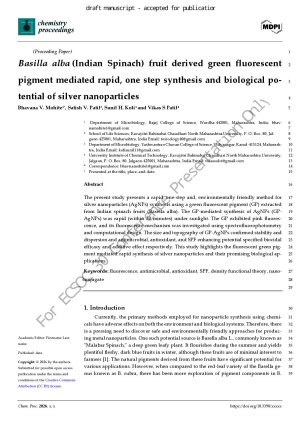
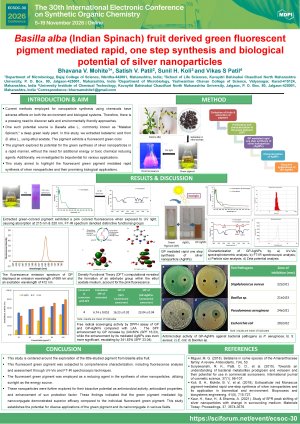
Introduction: Due to the adverse effects of chemically synthesized nanoparticles on both the environment and biological systems, there is a pressing need to discover a safe and environmentally friendly approach. The present study presents a rapid, one-step and, environmentally friendly method for producing silver nanoparticles (AgNPs) using a green fluorescent pigment (GP) extracted from Indian spinach fruits (Basella alba).
Methods: The GP exhibited pink fluorescence, and its fluorescence mechanism was investigated using spectrofluorophotometry and computational design. The GP-mediated synthesis of AgNPs (GP-AgNPs) was rapid, occurring within just 30 minutes under sunlight. The characteristics of GP-AgNPs, including size and topography, were precisely defined using various sophisticated analytical techniques. The antimicrobial, antioxidant, and SPF enhancing potential of GP and GP-AgNPs) was explored.
Results: The average size of the AgNPs was 102 nm, zeta potential of -12.1 mV, and a polydispersity index of 0.251, indicating stability and dispersion. The biocidal efficacy of GP-AgNPs was assessed against bacterial pathogens: Pseudomonas aeruginosa, Escherichia coli, Staphylococcus aureus, and Bacillus sp. Additionally, the potential of GP-AgNPs to enhance the sun protection factor (SPF) of commercial sunscreens was explored including additive effects. The antioxidant potential of GP-AgNPs and GP was133.87% and 140.01%, respectively, in comparison with 37.61% for L-Ascorbic acid.
Conclusion: This study highlights the fluorescent green pigment derived from a common leafy vegetable for the environmentally friendly, and rapid synthesis of silver nanoparticles without additional energy, and toxic chemical reducing agents. Furthermore, their promising biological applications were studied.
Keywords
fluorescence
antimicrobial
antioxidant
sun protection factor
density functional theory
nanoconjugate
Manuscript
[Sciforum-202328] - [Manuscript PDF] - [Submission accepted].pdf
Poster
[Sciforum-202328] - [Poster] - [Submission accepted].pdf
Efficient Synthesis of Tacrine Analogues Using 2-Aminothiophene-3-Carbonitril as a Key Precursor
Anti-Inflammatory Activity of Organic Extracts from Phyla lanceolata Leaves