Event submissions
Published
This submission belongs to the session Session 2. Chemistry of Bioorganics, Medicinal and Natural Products of the event The 30th International Electronic Conference on Synthetic Organic Chemistry
Published date
02 Nov, 2026
Academic Editor
 Julio A. Seijas
Citation
Ana Karina Arias-Cruz, Ever A. Blé-González, Manases González-Cortazar, Alejandro Zamilpa, Maribel Herrera-Ruiz, Anti-Inflammatory Activity of Organic Extracts from Phyla lanceolata Leaves, in Proceedings of The 30th International Electronic Conference on Synthetic Organic Chemistry, 5 November–19 November 2026, MDPI: Basel, Switzerland
Share
Email
Facebook
Twitter
LinkedIn
Anti-Inflammatory Activity of Organic Extracts from Phyla lanceolata Leaves

Ana Karina Arias-Cruz 1
Ever A. Blé-González 1

Manases González-Cortazar 2
Alejandro Zamilpa 2
Maribel Herrera-Ruiz 2
1. División Académica de Ciencias Básicas, Universidad Juárez Autónoma de Tabasco, Carretera Cunduacán Jalpa Km 0.5, Cunduacán 86690, Tabasco, Mexico
2. Centro de Investigación Biomédica del Sur, Instituto Mexicano del Seguro Social (IMSS), Argentina 1, Xochitepec 62790, Morelos, Mexico
Abstract
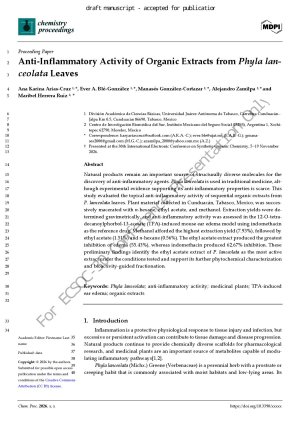
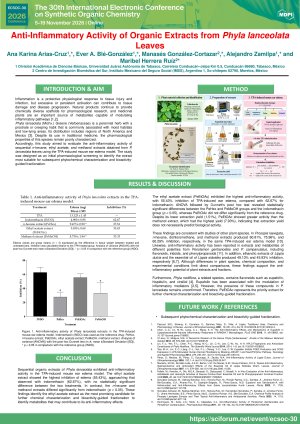
Introduction: Natural products remain an important source of bioactive compounds for the discovery of new anti-inflammatory agents. Phyla lanceolata has been traditionally used in folk medicine; however, scientific evidence supporting its anti-inflammatory potential is still limited. Therefore, the present study aimed to evaluate the anti-inflammatory activity of organic extracts obtained from the leaves of P. lanceolata. Methods: Leaves of P. lanceolata collected in Cunduacán, Tabasco, Mexico, were sequentially extracted by maceration using solvents of increasing polarity (n-hexane, ethyl acetate, and methanol). The extraction yields were determined gravimetrically. Anti-inflammatory activity was evaluated using the 12-O-tetradecanoylphorbol-13-acetate (TPA)-induced mouse ear edema model. Indomethacin was used as the reference anti-inflammatory drug. Results: Methanol afforded the highest extraction yield (7.93%), followed by ethyl acetate (1.51%) and n-hexane (0.56%). Among the tested extracts, the ethyl acetate extract exhibited the strongest anti-inflammatory activity, producing 55.43% inhibition of ear edema, which was comparable to the inhibition produced by indomethacin (62.67%). The methanolic and n-hexane extracts also reduced inflammation, although with lower inhibitory activity. Conclusions: The results demonstrate that P. lanceolata is a promising source of bioactive compounds with anti-inflammatory properties. In particular, the ethyl acetate extract showed remarkable pharmacological activity, suggesting that compounds of intermediate polarity may contribute to the observed effect. These findings provide a scientific basis for further phytochemical investigations to identify the active metabolites and for additional pharmacological and toxicological studies to evaluate their therapeutic potential and safety.
Keywords
Anti-inflammatory
extracts
Phyla lanceolata.
Manuscript
[Sciforum-202364] - [Manuscript PDF] - [Submission accepted].pdf
Poster
[Sciforum-202364] - [Poster] - [Submission accepted].pdf
Basilla alba (Indian Spinach) fruit derived green fluorescent pigment mediated rapid, one step synthesis and biological potential of silver nanoparticles
Click Chemistry as a Synthetic Strategy for the Preparation of Bis(indolyl)-1,2,3-triazole Analogues of Topsentin and Nortopsentin