Event submissions
Published
This submission belongs to the session Session 1. General Organic Synthesis of the event The 30th International Electronic Conference on Synthetic Organic Chemistry
Published date
02 Nov, 2026
Academic Editor
 Julio A. Seijas
Citation
Kapil Chahal, K. Rajender Reddy, Scandium-Catalyzed Ring Opening of Cyclopropane-Tethered 2-Phenylindoles: An Efficient Access to Functionalized Indolo[2,1-a]isoquinolines, in Proceedings of The 30th International Electronic Conference on Synthetic Organic Chemistry, 5 November–19 November 2026, MDPI: Basel, Switzerland
Share
Email
Facebook
Twitter
LinkedIn
Scandium-Catalyzed Ring Opening of Cyclopropane-Tethered 2-Phenylindoles: An Efficient Access to Functionalized Indolo[2,1-a]isoquinolines

Kapil Chahal 1
K. Rajender Reddy 1
1. Catalysis and Fine Chemicals Division, CSIR-Indian Institute of Chemical Technology, Hyderabad-500007, Telangana, India
Abstract
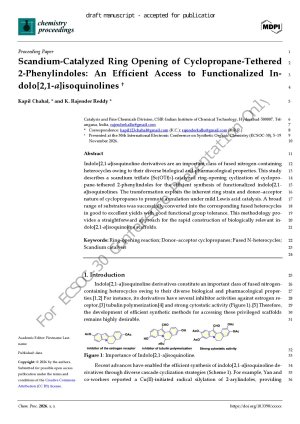
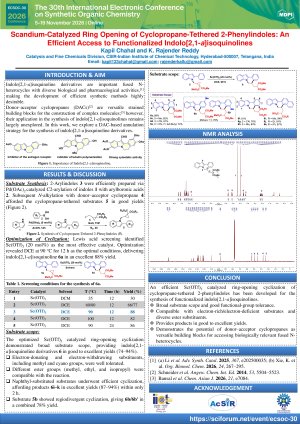
Introduction: Indolo[2,1-a]isoquinoline derivatives constitute an important class of fused nitrogen-containing heterocycles owing to their diverse biological and pharmacological properties. Therefore, the development of efficient synthetic methods for accessing these privileged scaffolds remains highly desirable. Donor–acceptor cyclopropanes, due to their inherent ring strain and unique reactivity under Lewis acid catalysis, have emerged as versatile building blocks for the construction of complex molecular architectures. Herein, we report a Sc(OTf)3-catalyzed ring-opening strategy for the synthesis of functionalized indolo[2,1-a]isoquinolines from cyclopropane-tethered 2-phenylindoles.
Methods: Cyclopropane-tethered 2-phenylindoles were synthesized and subjected to Lewis acid-catalyzed cyclization conditions. Following systematic optimization, Sc(OTf)3 was identified as an efficient catalyst for promoting the ring-opening transformation in 1,2-dichloroethane (DCE). The substrate scope was investigated using various substituted substrates, and the products were characterized by NMR spectroscopy and HRMS.
Results: The optimized protocol efficiently afforded functionalized indolo[2,1-a]isoquinoline derivatives in good to excellent yields. The methodology exhibited broad substrate scope and tolerated a variety of substituents on both the indole and aryl rings, providing rapid access to structurally diverse fused heterocycles under mild conditions.
Conclusion: An efficient Sc(OTf)3-catalyzed ring-opening strategy has been developed for the synthesis of functionalized indolo[2,1-a]isoquinolines. The protocol features mild reaction conditions, broad substrate scope, and good to excellent yields, offering a practical route to biologically relevant fused heterocyclic scaffolds.
Keywords
Ring-opening reaction
Donor–acceptor cyclopropanes
Fused N-heterocycles
Scandium catalysis
Manuscript
[Sciforum-199429] - [Manuscript PDF] - [Submission accepted].pdf
Poster
[Sciforum-199429] - [Poster] - [Submission accepted].pdf
Moringa oleifera and Its Phytochemicals Targeting Parkinson's Disease: Insights from Network Pharmacology
Investigation of the polyphenol and flavone content and the toxicity of the leaves of Pyrus communis L. from two regions of Romania