Event submissions
Published
This submission belongs to the session Session 2. Chemistry of Bioorganics, Medicinal and Natural Products of the event The 30th International Electronic Conference on Synthetic Organic Chemistry
Published date
02 Nov, 2026
Academic Editor
 Julio A. Seijas
Citation
Cristina Silvia Stoicescu, Robert Ancuceanu, Mihaela Dinu, Marilena-Viorica Hovanet, Adriana-Iuliana Anghel, Investigation of the polyphenol and flavone content and the toxicity of the leaves of Pyrus communis L. from two regions of Romania, in Proceedings of The 30th International Electronic Conference on Synthetic Organic Chemistry, 5 November–19 November 2026, MDPI: Basel, Switzerland
Share
Email
Facebook
Twitter
LinkedIn
Investigation of the polyphenol and flavone content and the toxicity of the leaves of Pyrus communis L. from two regions of Romania

Cristina Silvia Stoicescu 1

Robert Ancuceanu 2
Mihaela Dinu 2
Marilena-Viorica Hovanet 2
Adriana-Iuliana Anghel 2
1. Department of Chemical Thermodynamics, “Ilie Murgulescu” Institute of Physical Chemistry, Romanian Academy, 060021, Bucharest, Romania
2. Department of Pharmaceutical Botany and Cell Biology,“Carol Davila” University of Medicine and Pharmacy, Traian Vuia 6, Bucharest, Romania
Abstract
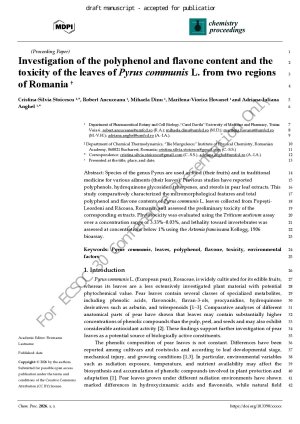
Species of the genus Pyrus are used as food (their fruits) but also in traditional medicine for various ailments (leaves). Previous studies show the presence of polyphenols, hydroquinone glycosides, triterpenes and sterols in leaf extracts.
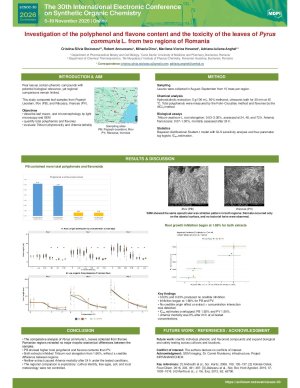
This work aims to evaluate the influence of environmental factors on the micro-morphological characteristics (using optical microscopy and SEM) polyphenol and flavone content (by spectrophotometric methods) of the leaves of the Pyrus communis L.(pear) cultivated in two regions of Romania (Vrancea, Ilfov), and assess the toxicity of pear leaf extracts.The cytotoxicity of solutions from the leaves of the pear on the plant cell was assessed using the Triticum phytobiological method in the concentration range 3.33%-0.03%. The influence on invertebrate animal organisms was tested at concentrations lower than 1% using the Artemia franciscana (Kellog, 1906) bioassay.
Extracts derived from Ilfov leaves showed a higher content of polyphenols (6.187 g gallic acid equivalents per 100 g product) and flavones (0.631 g quercetol equivalents per 100 g product). The Triticum test showed that both alcoholic extracts exhibit cytotoxic effects in a limited concentration range (3.3%-1.66%) and the one from Ilfov is stronger. The Artemia bioassay showed that both extractive solutions did not cause lethality in the tested range.
The findings indicate that climatic stress in Ilfov promoted higher polyphenol accumulation. Despite this increase in bioactive compounds, pear leaf extracts demonstrated no toxicity toward Artemia nauplii and exerted only a minor inhibitory effect on root elongation.
Keywords
Pyrus communis
leaves ,polyphenol
flavone,toxicity
environmental factors
Manuscript
[Sciforum-202436] - [Manuscript PDF] - [Submission accepted].pdf
Poster
ECSOC-30_Poster_Stoicescu_Anghel_Ancuceanu_et_al_A0_v2_rev_RA_MD_28.10.pdf
Scandium-Catalyzed Ring Opening of Cyclopropane-Tethered 2-Phenylindoles: An Efficient Access to Functionalized Indolo[2,1-a]isoquinolines
Integrated In Silico Quantum Chemical and Molecular Docking Analysis for the Identification of Natural Compounds Targeting the Pathological Tau Protein Associated with Alzheimer's Disease