Event submissions
Published
This submission belongs to the session Session 2. Chemistry of Bioorganics, Medicinal and Natural Products of the event The 30th International Electronic Conference on Synthetic Organic Chemistry
Published date
02 Nov, 2026
Academic Editor
 Julio A. Seijas
Citation
Faiza BOUKLI-HACENE, Hocine ALLALI, Hafida CHEMOURI, Computational Insights into the Carbonic Anhydrase II Inhibitory Potential of Piperidin-4-one Based Curcuminoids: An Integrated Docking and DFT Study, in Proceedings of The 30th International Electronic Conference on Synthetic Organic Chemistry, 5 November–19 November 2026, MDPI: Basel, Switzerland
Share
Email
Facebook
Twitter
LinkedIn
Computational Insights into the Carbonic Anhydrase II Inhibitory Potential of Piperidin-4-one Based Curcuminoids: An Integrated Docking and DFT Study

Faiza BOUKLI-HACENE 1
Hocine ALLALI 2
Hafida CHEMOURI 3,4
1. Laboratory of Natural and Bioactive Substances (LASNABIO), Department of Chemistry, Faculty of Sciences, Abou Bekr Belkaïd University, Tlemcen, 13000, Algeria
2. Spectrochemistry and Structural Pharmacology Laboratory (LSPS), Department of Chemistry, Faculty of Sciences, Abou Bekr Belkaïd University, Tlemcen, 13000, Algeria
3. Laboratory of Applied Thermodynamics and Molecular Modeling, Department of Chemistry, Faculty of Science, Abou Bekr Belkaïd University, Tlemcen, 13000, Algeria
4. Higher School of Applied Sciences of Tlemcen (ESSA-Tlemcen), Higher School of Applied Sciences of Tlemcen (ESSA-Tlemcen), Tlemcen, 13000, Algeria
Abstract
As a predominant factor in permanent visual impairment, glaucoma management relies heavily on the systemic or topical modulation of intraocular pressure via Carbonic Anhydrase II (CA-II) inhibition. This investigation details the experimental evaluation and theoretical profiling of nine curcumin-inspired scaffolds functioning as non-sulfonamide CA-II antagonists. In vitro screening identified 3,5-bis[(2-hydroxyphenyl)methylidene]piperidin-4-one as the primary lead, demonstrating a remarkable inhibitory capacity of 81.44% and a sub-micromolar potency (IC50 = 7.92 µM). To resolve the molecular foundations of this activity, an integrated computational framework was employed, bridging molecular docking with conceptual Density Functional Theory (DFT). Simulation data indicate that high-affinity binding is contingent upon the ligand’s precision in navigating the catalytic cleft to establish essential stabilising networks with the Thr199 residue, effectively emulating the binding mode of clinical sulfonamides. Complementary DFT assessments confirm that inhibitory success is fundamentally governed by electronic reactivity descriptors. Specifically, the most efficacious derivatives are characterised by heightened nucleophilicity, elevated EHOMO levels, and reduced chemical hardness (8.53 eV), which collectively facilitate transient electronic polarisation and efficient charge transfer toward the Zn2+ metal centre. These insights are further validated by Molecular Electrostatic Potential (MEP) topography, which underscores the requirement for electrostatic complementarity during the initial recognition phase. Ultimately, these findings position curcumin-based architectures as biocompatible and electronically optimised templates for the rational development of next-generation antiglaucoma therapeutics.
Keywords
Glaucoma
CA-II
Curcuminoids
DFT
Nucleophilicity
Docking
SAR
Manuscript
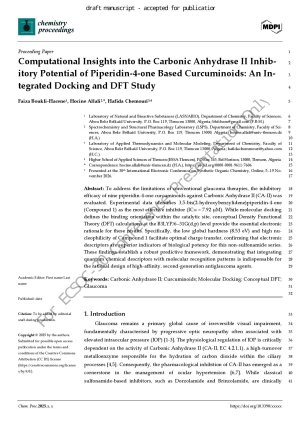
[Sciforum-202457] - [Manuscript PDF] - [Submission accepted].pdf
Poster
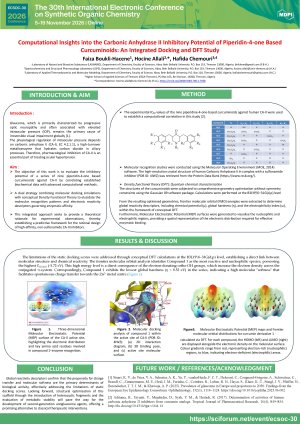
FAIZA_ECSOC30-5-19 NOV_2026 .pdf
Further phytochemical investigation on Salvia melissodora
Flow Chemistry in the Synthesis of a Model API with Organometallic Reagents: Thermodynamic Efficiency and Process Safety within the Framework of “Green Chemistry”