Event submissions
Published
This submission belongs to the session Session 1. General Organic Synthesis of the event The 30th International Electronic Conference on Synthetic Organic Chemistry
Published date
02 Nov, 2026
Academic Editor
 Julio A. Seijas
Citation
Victoriya Georgiyants, Matvii Vernydub, Flow Chemistry in the Synthesis of a Model API with Organometallic Reagents: Thermodynamic Efficiency and Process Safety within the Framework of “Green Chemistry”, in Proceedings of The 30th International Electronic Conference on Synthetic Organic Chemistry, 5 November–19 November 2026, MDPI: Basel, Switzerland
Share
Email
Facebook
Twitter
LinkedIn
Flow Chemistry in the Synthesis of a Model API with Organometallic Reagents: Thermodynamic Efficiency and Process Safety within the Framework of “Green Chemistry”

Victoriya Georgiyants 1
Matvii Vernydub 2,3
1. Pharmaceutical Faculty, Pharmaceutical Chemistry Department, National University of Pharmacy, 53 Pushkinska Str., Kharkiv, 61002, Ukraine
2. JSC "Farmak", 63 Kyrylivska Str., Kyiv, 04080, Ukraine
3. National University of Pharmacy, 53 Pushkinska Str., Kharkiv, 61002, Ukraine
Abstract
The synthesis of active pharmaceutical ingredients (APIs) frequently involves highly reactive organometallic reagents, such as organolithium compounds. Their pyrophoric nature and thermal instability necessitate cryogenic conditions (down to –78 °C) in conventional batch reactors. This requirement imposes severe constraints on industrial scalability, demands complex cryogenic infrastructure, and results in excessive energy consumption. Moreover, handling large volumes of such reagents in batch mode increases the probability of uncontrolled exothermic events and thermal runaway.
To evaluate the transition from batch to continuous flow systems as a strategy for safe and energy‑efficient synthesis of a model API employing organometallic reagents.
A laboratory‑scale flow reactor equipped with precision mixing zones was utilized to optimize kinetic parameters and residence time distribution. Analytical monitoring of intermediates and the final compound was performed using high‑performance liquid chromatography (HPLC) and gas chromatography (GC).
Results.
Thermal management: The instantaneous reaction volume in flow systems (~10 mL) enables rapid heat dissipation, eliminating hot‑spot formation and allowing reactions to proceed at elevated temperatures without compromising selectivity. Reaction kinetics: Enhanced mass and heat transfer accelerate reaction rates, reducing cycle time and increasing throughput per unit of equipment. Yield improvement: Product yield increased by approximately one‑third compared to batch synthesis. Energy balance: Cooling 1 L of reaction mixture from 25 °C to –78 °C in batch mode requires ~420 kJ (assuming specific heat capacity of 4.2 kJ/(kg·K)). In contrast, cooling an instantaneous volume of 10 mL in flow mode requires only ~4.2 kJ. This corresponds to a nearly 100‑fold reduction in energy demand, directly aligning with the principles of “green chemistry.”
Keywords
Flow chemistry
Organometallic reagents
API synthesis
Thermodynamic efficiency
Green chemistry
Manuscript
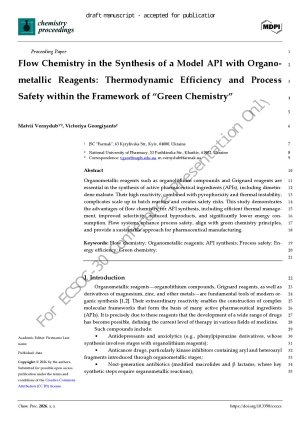
[Sciforum-201203] - [Manuscript PDF] - [Submission accepted].pdf
Computational Insights into the Carbonic Anhydrase II Inhibitory Potential of Piperidin-4-one Based Curcuminoids: An Integrated Docking and DFT Study
A COMPUTATIONAL APPROACH FOR THE DESIGN AND SYNTHESIS OF SOME THIAZOLIDINE-2,4-DIONE DERIVATIVES AS POTENTIAL ANTIDIABETIC AGENTS TARGETING PEROXISOME PROLIFERATOR-ACTIVATED RECEPTOR GAMMA (PPARγ)